Vul. Konovaltsia, 18 – residential building ID: 2698
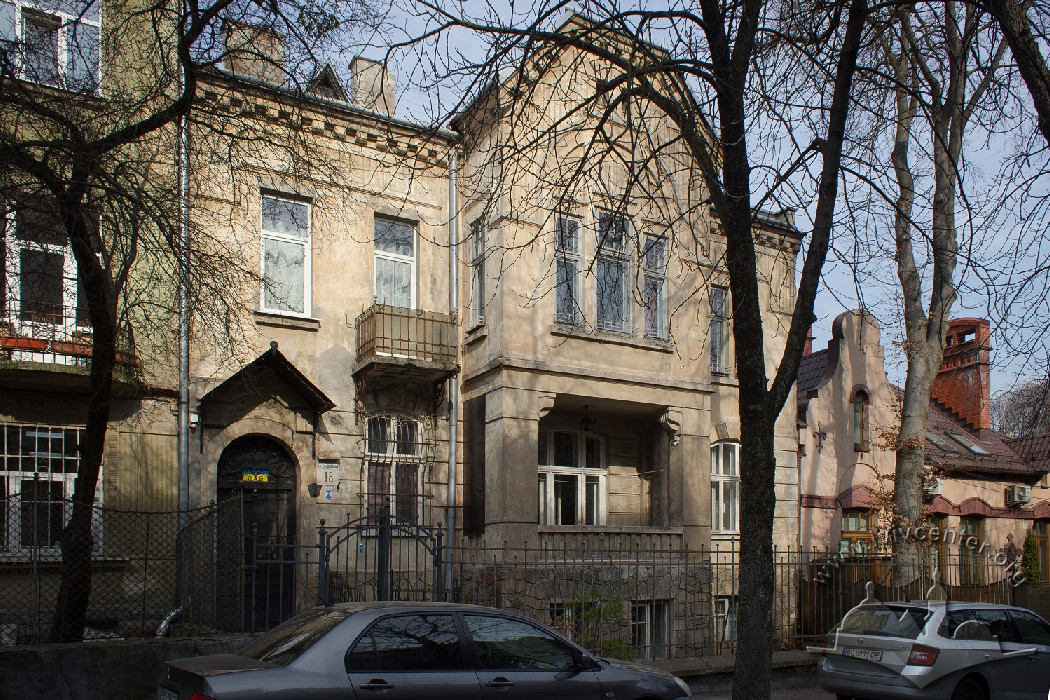
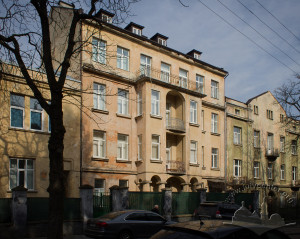
This two-story residential building was constructed in 1908–1909 according to a project designed by Adam Opolski for Marja Bertemilijan Brajer. Later, it belonged to the Foundation for the Blind, which was founded by the Brajers. It is an architectural monument of local significance.
Story
The plot for this building was formed in the late 19th century. A larger plot with conscription number 86 ¼, which belonged to ul. Na Bajkach (now vul. Kyivska). The archive file for house 18 contains a document from 1878 in which the Magistrate asks the owners of the plot, Michał and Walenty Borecki, to build a well curb of the correct height (ДАЛО 2/1/3370:1). Part of the plot was purchased in the same year by Szymon Jarka, who planned to build a single-story house with four rooms and a hallway there (ДАЛО 2/1/3370:4). The owner received permission, and the house was to be built along the frontage line of ul. Na Bajkach (now vul. Kyivska); however, the file does not reveal if the project was implemented.
In 1892, the boundaries of the plot were adjusted due to the construction of ul. 29 Listopada (now vul. Konovaltsia).
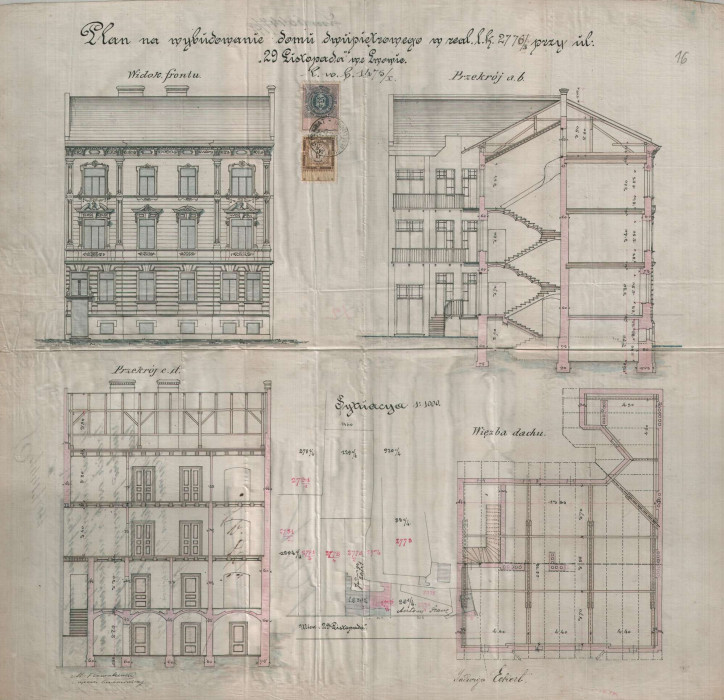
In 1897, Jadwiga Eckert — probably a relative of the owners of the neighboring plot 129 ¼, which belonged to ul. Sadownicka (now vul. Antonovycha) — commissioned a project for a three-story townhouse from Michał Kowalczuk. Stanisław Krzyżanowski, an architect from the city building authority who reviewed the submitted project, had a number of comments and recommended that it not be approved (ДАЛО 2/1/3370:8). Based on his expert opinion, Kowalczuk prepared new drawings, which were approved on September 27, 1897 (ДАЛО 2/1/3370:16).
The archive does not contain any further information about whether the building was constructed. Most likely, it was not. Indirect evidence of this is the numbering of houses. From 1892, ul. 29 Listopada began at the intersection with ul. Na Bajkach (now vul. Kyivska), and around 1912 it was extended to ul. Sapiehy (now vul. Bandery). Therefore, house 18 should have been numbered 6 at first. However, in 1900, this number was assigned to the villa of Mikołaj Rybowski at what is now vul. Konovaltsiaz 26.
In 1908, this part of the plot was purchased by Marja Bertemiljan Brajer. She was the wife of a Lviv entrepreneur who, in the 1880s and 1890s, built townhouses on several streets in Lviv, including contemporary vul. Bohdana Lepkoho and vul. Yevhena Hrebinky. Consequently, that neighborhood was informally named "Brajerówka".
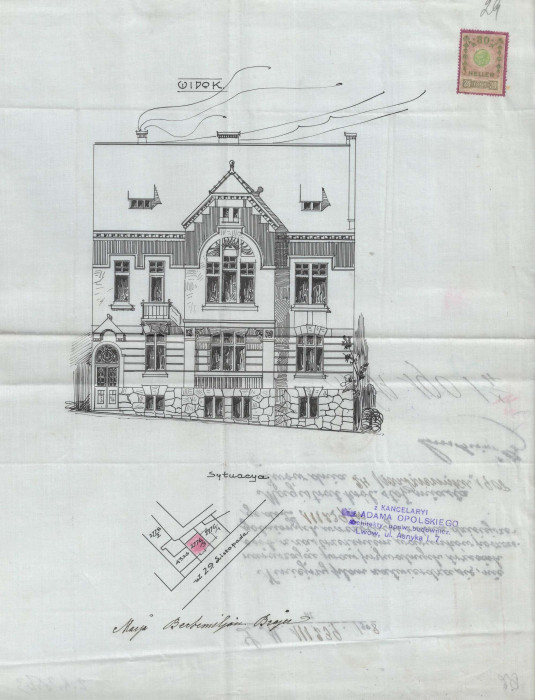
The house was designed for Marja Brajer by architect Adam Opolski. It was a two-story building that looked more like a villa than a tenement townhouse. It consisted of four apartments, two on each floor. In October 1908, the Lviv Magistrate approved the project and construction began (ДАЛО 2/1/3370:27-33). However, during the construction, the owner and the architect decided to increase the number of residential units. To do this, they built a higher semi-basement floor to provide more sunlight. When requesting approval for these changes to the project, they emphasized that it was on the sunny side, the ground was dry, the walls were “asphalted” (covered with waterproof materials), and that these basement rooms would be accessible to less affluent Lviv residents. At the end of 1909, the building was completed, and the owner received a permit to move in (ДАЛО 2/1/3370:38-41).
Further archival records about the building are interrupted. The next document dates from February 1930, when Jan Żuk, a tenant, complained to the Lviv Magistrate that the building's caretaker, Ignacy Popowicz, had unauthorizedly taken over the laundry room in the basement and set up a storage room there (ДАЛО 42). Żuk appealed to the city authorities because the building administrator, Stanisław Niewiadomski, was in Warsaw at the time, leaving the matter to his deputy, Andrzej (Jędrzej) Kozin, a resident of ul. Trzeciego Maja 16 (now vul. Sichovykh Striltsiv), with whom the tenants may have had a misunderstanding. In addition to the illegality of the caretaker's actions, Żuk also used the argument of hygiene. Washing and drying clothes inside the apartments, he claimed, caused high humidity, which made children sick. Three other tenants — Mieczysław Rożański, Grzegorz Grodzicki, and Captain Fink's wife — supported Żuk. It seems that the city authorities were in no hurry to do anything, and in March 1931, the complaint was transferred to the archives (ДАЛО 2/1/3370:42). In 1939, Popowicz was tried for closing the gate of this building prematurely in the evenings, thus causing conflicts with the residents (Chwila, 1939, No. 732, p. 5).
In June 1931, Captain Włodzimierz Fink called the district police station and reported that the porch of his house had collapsed. The police confirmed that the railing of the balcony belonging to Fink's apartment on the rear side of the house had broken. The building administrator, Andrzej Kozin, accused the tenant of deliberate destruction. The document also contains a note from October 1932 stating that the balcony had been allegedly repaired (ДАЛО 2/1/3370:43).
In May 1933, the Lviv Magistrate asked his construction department whether (and what kind of) repairs were needed for this building. The property is referred to as “foundational” (ДАЛО 2/1/3370:44). A few months later, the president of Lviv repeated the question (ДАЛО 2/1/3370:45). In the response, which was compiled after an inspection, they noted the need to repair the balconies — balustrades and slabs — as well as the rear facade in general, and estimated the cost of the work at 500 zlotys (ДАЛО 2/1/3370:46-47). This was followed by an investigation into who was responsible for the property: the “lifelong residents” Stanisław and Zofia Niewiadomski lived in Warsaw, and the Magistrate was unable to find out their exact address (ДАЛО 2/1/3370:48). Therefore, it was decided to contact Andrzej Kozin as the administrator. As it turned out, he had died, so his widow Marja had to take care of the repairs in 1934 (ДАЛО 2/1/3370:53). Later, in 1935, she and her family moved into this house, now owned by Śliwińska (ДАЛО 2/1/3370:55).
Today (2025), the house remains residential. It is likely that the interior has been remodeled.Architecture
The two-story building with a basement is located in a row of buildings 6 m from the sidewalk and has a metal fence on the foundation, preserved from the period of its construction.
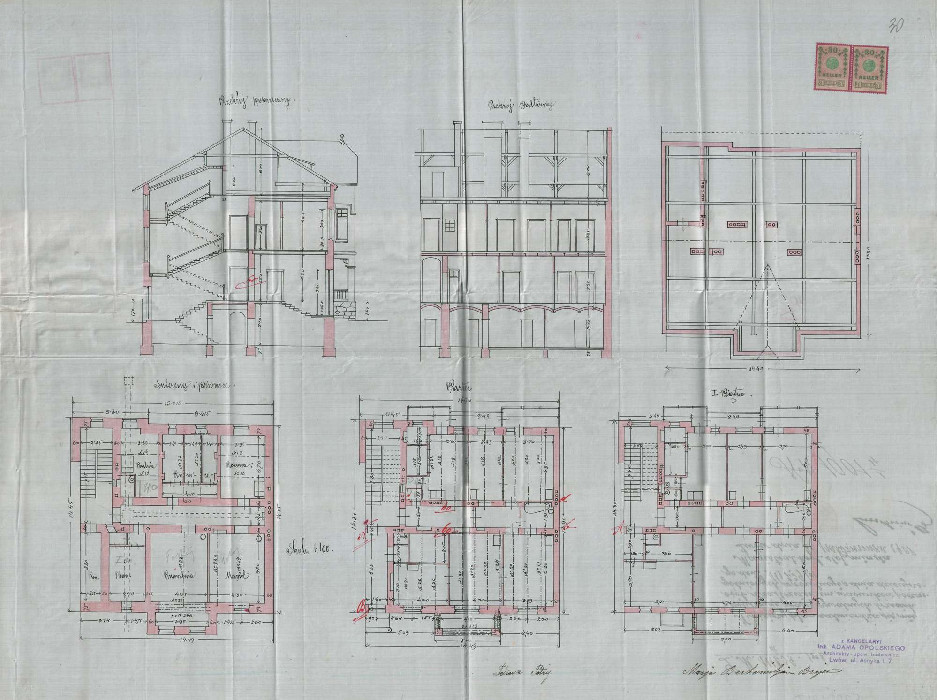
The plan of the house is close to a square (dimensions 14.49 by 14.30 m). According to the original design, it is built of brick, with brick ceilings on metal beams above the basement, flat inter-floor slabs (also on metal beams), and a wooden attic (ДАЛО 2/1/3370:30). The basement is faced with broken stone while the rest of the façades is plastered with cement mortar, with concrete used for lintels, window sills, and balconies. The roof is covered with tin; the project shows a roof made of shingles.
From the outside, the building resembles a villa; however, it is an apartment building. According to the original plan, each floor had two two-room apartments with separate kitchens having niches for maids and toilets but with a shared corridor and bathroom. Each apartment faces either the street or the courtyard and is designed with an open terrace (ground floor) or a loggia (second floor). The rooms were heated by stoves.
The building, designed by Adam Opolski's bureau, resembles the architect's other works, primarily on what is vul. Vyshenskoho today. Around 1908, low-rise apartment buildings resembling villas from the outside were built there as well. The external form and style are also similar. The façade is close to symmetry, with a terrace on a foundation in the center, with two massive pillars supporting a bay window-loggia on the second floor, which is topped with a gable. The entrance is located on the side, on the outer axis. The ground floor’s surface is rusticated, above it is smooth; part of the plane above the second floor windows is separated by a curved cornice and has a decorative texture in the plaster, reminiscent of wooden planks. The façade is topped with a cornice featuring massive denticles. The design and the completed building are almost identical. Above the main entrance, there is a sculptural All-Seeing Eye, while in the design it was planned above the bay windows.
The style combines elements of classical architecture (such as rustication), the influence of Secession in the fanciful forms of wrought-iron balcony consoles and plaster texture, as well as Neo-Gothic elements such as a broken cornice, massive denticles, and stylized mullions in the triforium windows of the bay. With this combination of historical elements, the architect achieved a rather picturesque effect.
Related buildings and spaces
-
Vul. Konovaltsia, 22 – hospital building (former residential)
People
Michał & Walenty Borecki — owners of the old plot 86 ¼ from
which the plot for this house was allocated.
Emil Bertemiljan Brajer — an entrepreneur who initiated the
construction of "Brajerówka" in the 1880s; a resident of the house in 1913.
Marja Bertemiljan Brajer — the first owner of the house who
commissioned its construction and lived nearby at ul. 29 Listopada 11 (now probably
vul. Kyivska 27) during the construction.
Grzegorz Grodzicki — a tile master who lived in the
house in the 1930s.
Jadwiga Eckert — owner of the plot who
commissioned a project for a house on it that was not implemented.
Jan Żuk — a shoemaker who lived in the house in the 1930s.
Michał Kowalczuk — an architect who designed a project
of a house for Jadwiga Eckert that was not implemented.
Andrzej (Jędrzej) Kozin (Kozień) — an insurance company clerk in
1914 who lived in the house at various times.
Marja Kozienowa — Andrzej's wife,
(co-)administrator of the house and its resident.
Stanisław & Zofia Niewiadomski — listed as "lifelong residents" of
the house, who moved to Warsaw in the early 1930s.
Adam Opolski — an architect who designed the house.
Ignacy Popowicz — a caretaker of the house in the
interwar period with whom the residents had numerous conflicts.
Mieczysław Rożański — a resident of the house in the
1930s.
Włodzimierz Skut — an employee who lived in the
house in 1935.
Józef Chomiński — a musician who lived in the house
in 1935.
Józefa Chomińska — a resident of the house in 1935.
Włodzimierz Fink — a resident of the house in the
1930s; he is listed as a captain in the archive file and as "Fick, an office
worker" in the 1935 address book.
Szymon Jarka — owner of the old plot 86 ¼ from
which the plot for this house was allocated; probably a butcher who lived on
ul. Janowska (now vul. Shevchenka) in the 1880s.
Sources
- Державний архів Львівської області (ДАЛО) 2/1/3370. URL: https://e.archivelviv.gov.ua/file-viewer/230149#file-1347845
- "Dozorca ukarany za przedwczesne zamknięcie bramy", Chwila, 1939, Nr. 7312, s. 5.
- Księga adresowa król. stoł. miasta Lwowa, 1913.
- Księga adresowa król. stoł. miasta Lwowa, 1914.
- Księga adresowa Małopolski, 1935.