Vul. Konovaltsia, 14 – residential building ID: 2696
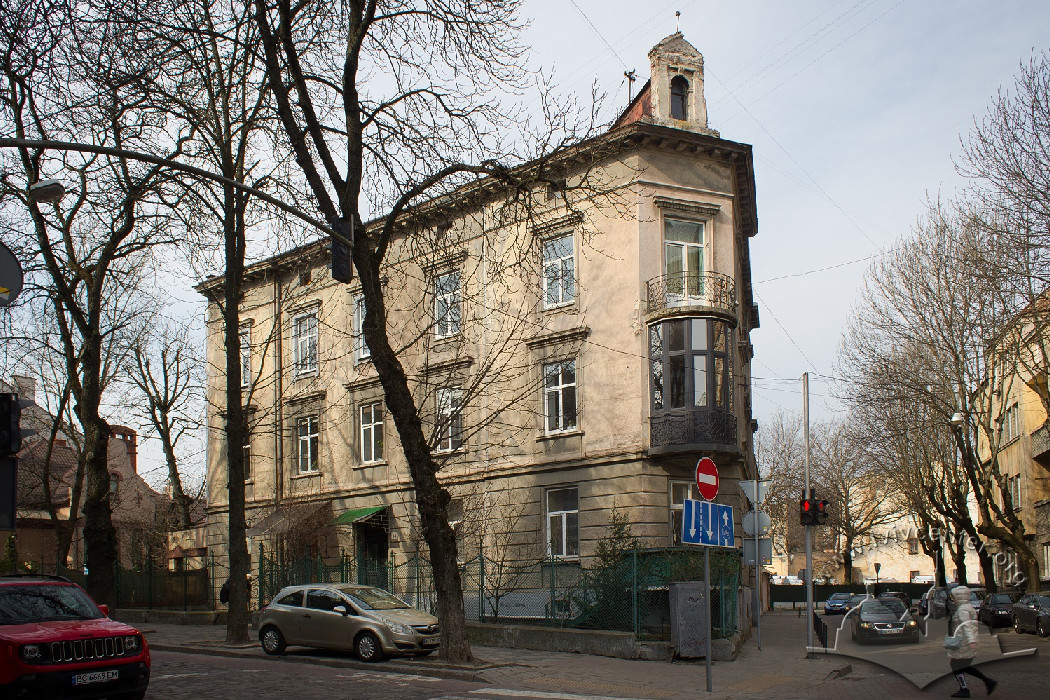
This three-story residential building was constructed in 1905–1906 by Karolina and Henryka Braunseis according to a design by their father, Joseph. It is a typical tenement townhouse in the Historicist style.
Story
The building plot was allocated from a larger plot, which during the 19th century was designated conscription number 86 ¼. In the middle of that century, it was owned by Józef Wojciechowski, later by Michał and Walenty Borecki, and in the early 20th century by Antoni Franz, a co-owner of a plaster factory.
Around 1905, Karolina and Henryka, each signed as Braunseisowna, purchased a small plot here from Antoni Franz. They were probably the daughters of Joseph Braunseis, a Lviv engineer and constructor. Joseph was a long-time employee of the technical department of the governor’s office, which was involved in the design and construction of public buildings. By that time, the 67-year-old Braunseis had already retired and lived on ul. Św. Jacka (now vul. Arkhypenka), at least according to the 1904 Lviv address book. He designed the building at ul. 29 Listopada 2 (now vul. Konovaltsia 14) and, after the construction was completed, moved in and lived there until his death in 1915.
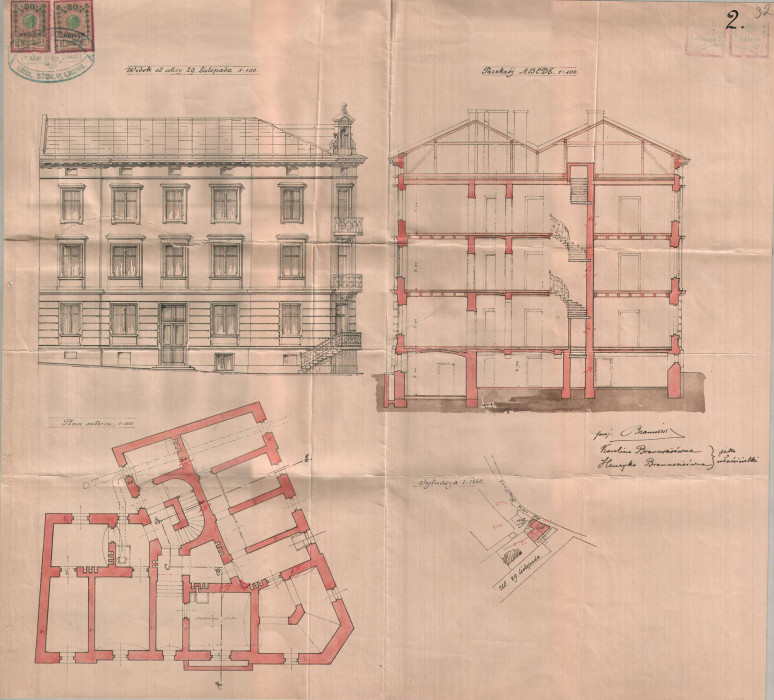
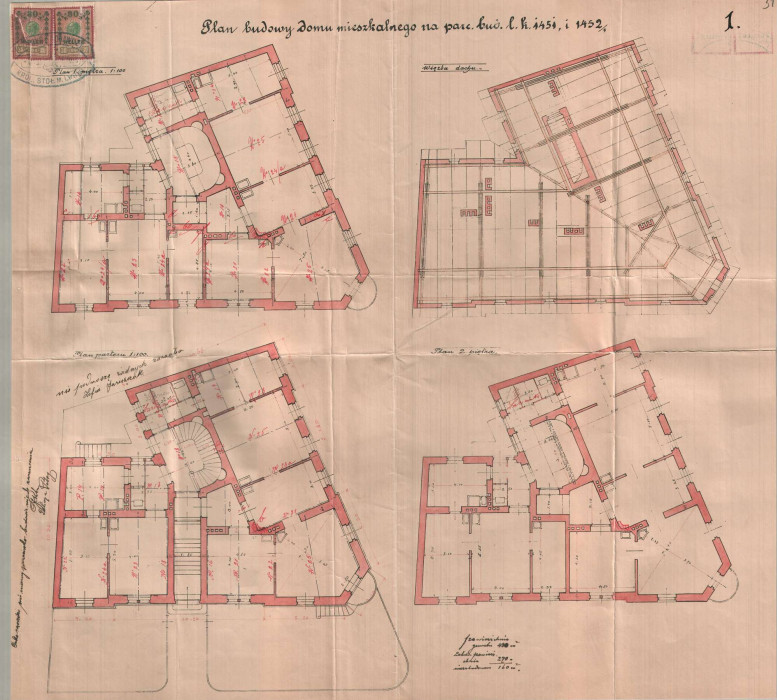
The project was approved by the Lviv Magistrate in June 1905 (ДАЛО 2/1/3366: 1, 31-32). In September 1906, the owners received permission to move into the house (ДАЛО 2/1/3366: 4-5). Soon, advertisements appeared in newspapers that apartments in the house were available for rent. "Two beautiful front rooms, one with a balcony and an entrance hall on the second floor in a healthy part of the city on the corner of ul. 29 Listopada 2, close to the tram. Available for rent from November 1, with or without maintenance, for older men, employees, bachelors, or pensioners. Information available from the caretaker on site or at Bieniecki’s confectionery", — such an announcement, for example, appeared in the classifieds section of the Kurjer Lwowski on October 20, 1906. So it seems that the daughters of Braunseis took up the maintenance of the boarding house.
Initially, the building was located at ul. 29 Listopada 2, as the street did not yet reach what is now vul. Bandery but began just from the contemporary vul. Kyivska. The current numbering system was introduced in 1912. After the construction was completed, the building was also assigned conscription number 1710 ¼.
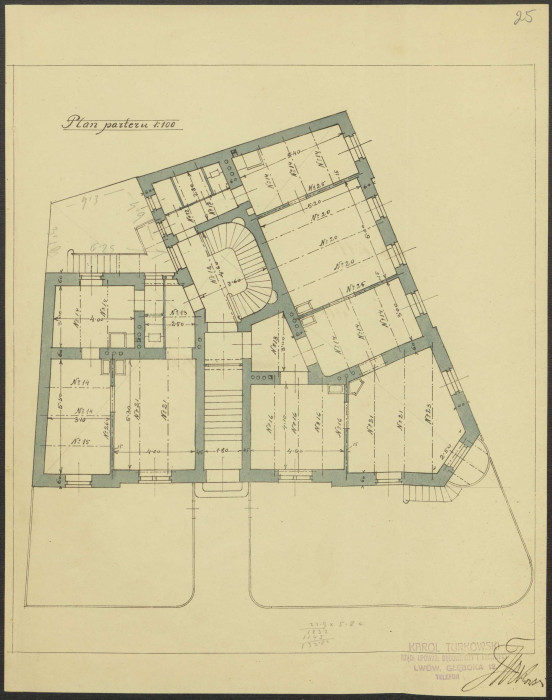
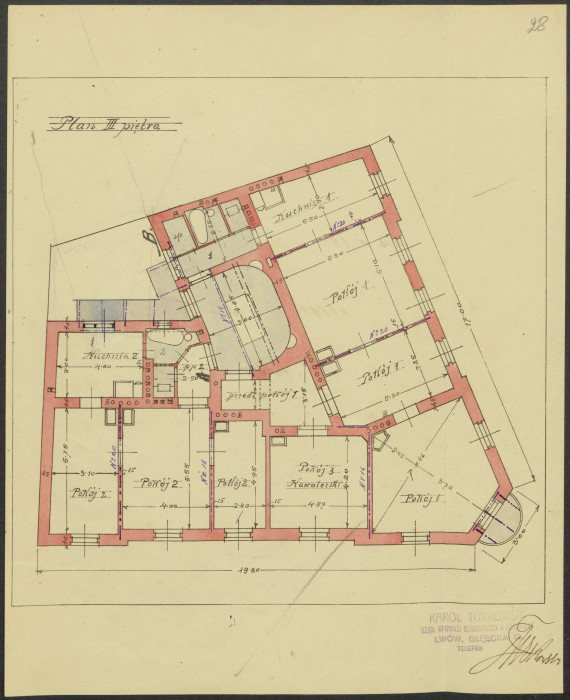
According to the approved drawings, there were two apartments on each floor. One was a two-room apartment with a kitchen (three rooms on the second and third floors) and a toilet, and the other was a four-room apartment with a kitchen, a separate toilet, and a bathroom. In the basement, to the right of the entrance, there was to be a small room for the caretaker for which a larger window was planned. The drawings were signed by the owners of the neighboring plots: Felicja Petry (contemporary vul. Konovaltsia 16) and Zofia Jaroszczak (contemporary vul. Kyivska 31).
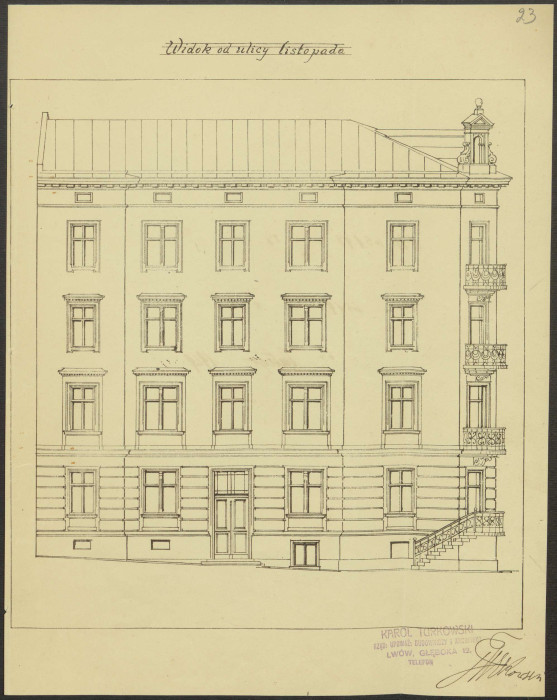
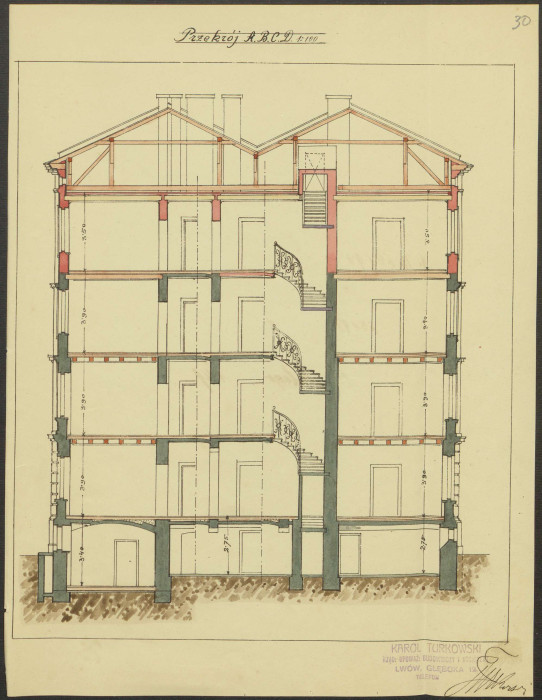
In the late 1920s, the house was purchased by Antoni Łukasiewicz, a Polish Army officer, and his wife Zofia. In 1929, they decided to add a fourth floor and commissioned a project from the constructor Karol Turkowski. According to the drawings, the style of the building was to remain unchanged, with the façade topped with a quite similar entablature and a corner attic: perhaps they planned to raise the old elements by one floor (ДАЛО 2/1/3366: 23). The layout of the new floor was to be slightly different: a bathroom was to be added to the smaller apartment while one room was to be parted from the larger apartment to create a separate "bachelor apartment" (ДАЛО 2/1/3366: 27-28). However, the Magistrate did not approve these drawings, arguing that the superstructure would adversely affect the lighting of neighboring buildings. The Łukasiewiczs appealed, but the fourth floor never appeared here.
Today (2025), the building remains residential. It has probably undergone some redesigns. On the ground floor, to the left of the entrance, there is a beauty salon.
Architecture
The building is a fairly typical example of a Historicist-style tenement townhouse.
It was built with a simultaneous connection to the city sewer system. One apartment on each floor was originally planned to have only a toilet, while the other also had a bathroom. This may indicate that the owners were targeting tenants with different payment capacities, as well as the fact that bathrooms were not yet the norm at that time.
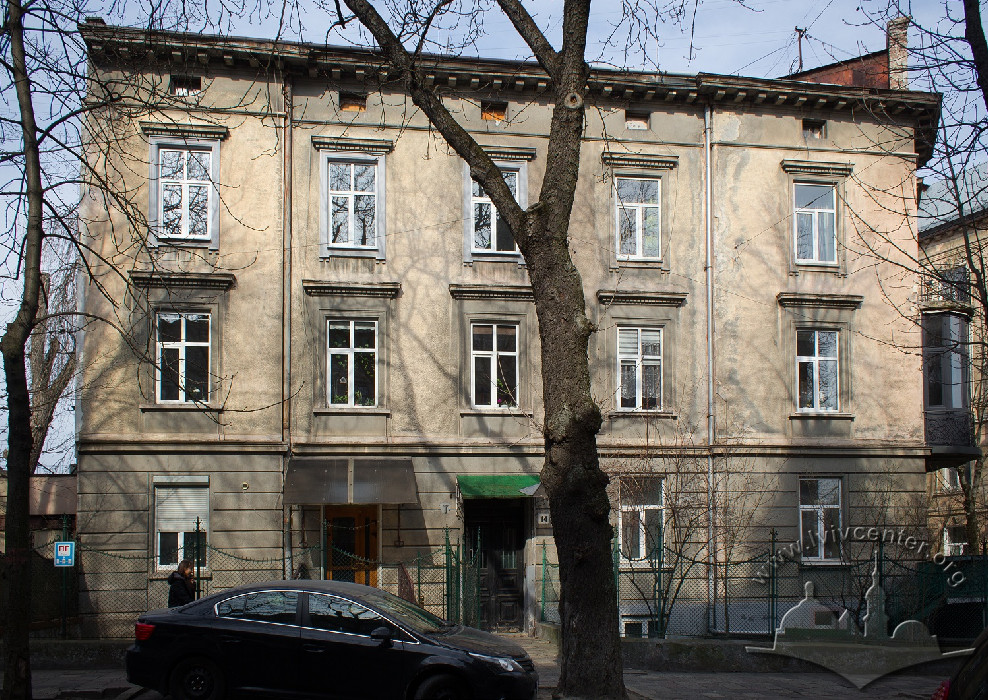
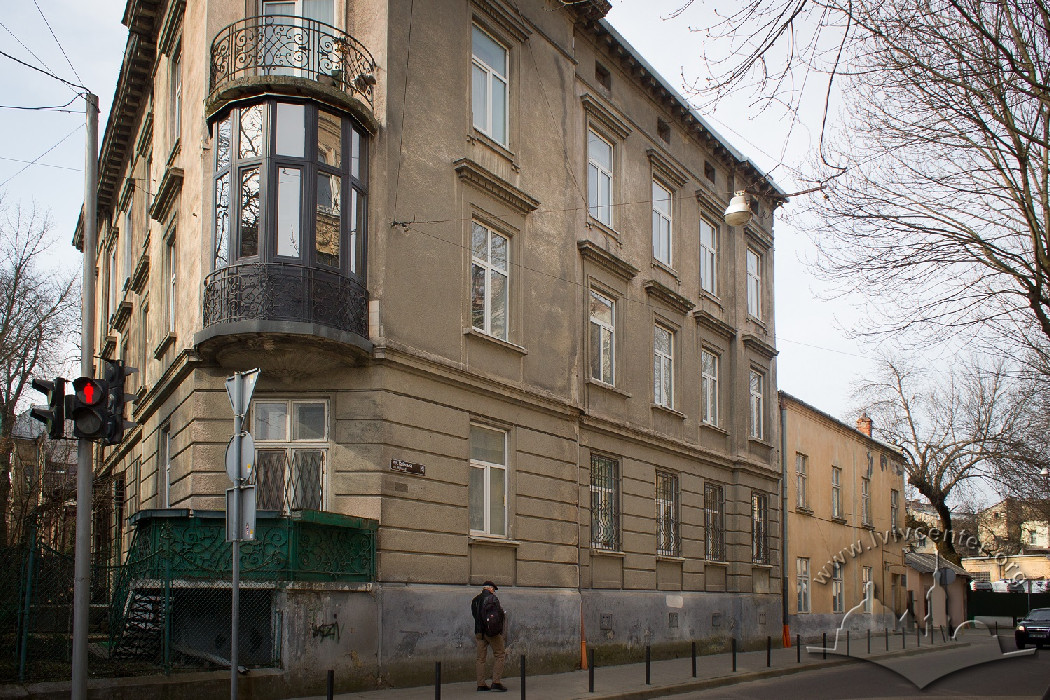
The building’s façades are almost symmetrical. They have a traditional façade structure — the ground floor is emphasized with rustication and separated by an inter-floor stringcourse, while the rest of the façade is smooth. The windows have simple profiled trimmings, complemented by linear cornices on the second and third floors. The façades are topped with an entablature having a row of small attic windows in the frieze. Balconies with metal railings are located on the cut corner, which is topped with a Neo-Baroque attic that features volutes and has been significantly damaged due to atmospheric factors. According to the design, Secession elements were to be used on the third floor balcony.
Externally, the building has largely retained its authentic features. However, most of the window woodwork has been replaced with metal-plastic one, and the second floor balcony has been glazed in a discordant manner. The layout of the apartments was probably changed in connection with the nationalization of the building in the 1940s and the privatization of the 1990s.
People
Michał and Walenty Borecki — previous owners of the plot 86 ¼.
Wiktorja, Włodzimierz, & Czesław Błonarowicz — a widow, a dental technician, and a land-surveyor,
respectively, who lived in the building (1935).
Joseph Braunseis (1837−1915) — an engineer and a
constructor who designed the house and lived in it later.
Karolina Braunseisówna — a co-owner of the building.
Henryka Brauseisówna — a co-owner of the building.
Stefania Weimes — a retiree who lived in the
building (1914).
Józef Wojciechowski — owner of the larger plot 86 ¼ in the mid-19th century.
Maria Durska — a teacher, the widow of the head
of the Polish society Sokół who lived in the building until 1915.
Łucjan Kierski — a merchant who lived in the
building (1935).
Otton Kryda — a mechanical engineer who lived
in the building (1935).
Antoni Łukasiewicz — a Polish Army officerv who
co-owned the house from the late 1920s till 1939.
Zofia Łukasiewicz — wife of Antoni Łukasiewicz, a
co-owner of the building.
Mikołaj Tworydło — an agronomist who lived in the
building (1935).
Adam Nadachowski — a technical inspector who lived
in the building (1914).
Felicya Petry — a co-owner of the neighboring
house No. 16.
Emilja Peszyńska — a doctor of medicine and a
physician who lived in the building (1935).
Karol Turkowski — a constructor who designed the
fourth floor extension (1929).
Marceli Fedyński — a legal advisor who lived in the
building (1914).
Antoni Franz — a previous owner of the larger
plot 86 ¼.
Luiza Chwalibogowa — a property owner’s widow who
lived in the building (1935).
Adam Czyżyk — a Polish railway official who
lived in the building (1935).
Zofia Jaroszczak — a co-owner of the neighboring
plot at vul. Kyivska 31.
Sources
- Державний архів Львівської області (ДАЛО) 2/1/3366. URL: https://e.archivelviv.gov.ua/file-viewer/230145#file-1353629
- Księga adresowa król. stoł. miasta Lwowa (1904).
- Księga adresowa król. stoł. miasta Lwowa (1914).
- Księga adresowa Małopolski (Lwów, Stanisławów, Tarnopol, 1935).
- Kurjer Lwowski, 1906, Nr. 286, s. 8.
- "Nekrologia", Kurjer Lwowski, 1915, Nr. 16, s. 4.
- Kurjer Lwowski, 1918, Nr. 390, s. 7.