Vul. Konovaltsia, 10 – residential building ID: 1382
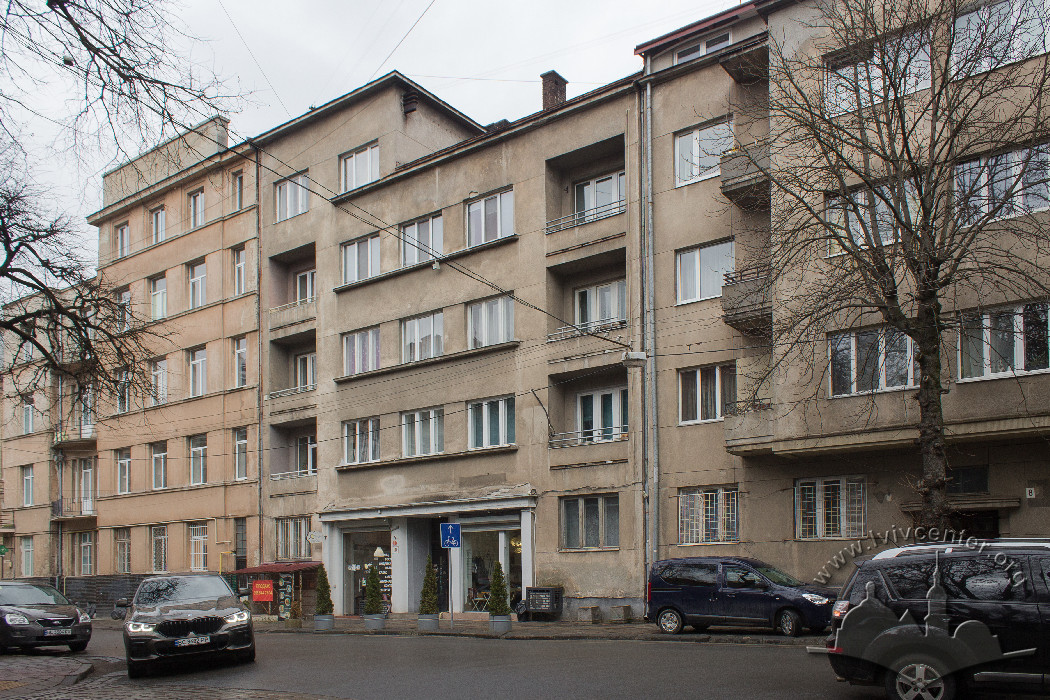
The residential building — four stories with a five-story section — was built in 1936–1937 according to a design by Salomon Keil for merchant Lazar Kalisch. It is a striking example of modernist architecture. Today, there are coffee shops on the ground floor.
Story
In the 19th century, the area between what is now vul. Konovaltsia, vul. Kyivska, and vul. Bandery belonged to the plot with conscription number 82-83 ¼. It is likely that the newly laid part of vul. Konovaltsia was parceled before the First World War, but the plot on which the modernist building would later be erected remained undeveloped for a long time.
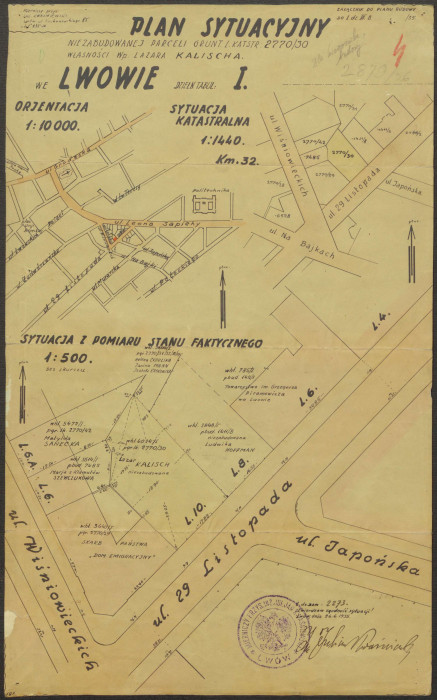
In 1935, the owner of the undeveloped plot was Joachim Tisch — probably Józef Joachim Tisch, an architect and building contractor. In June of that year, the City Council asked him to repair the old, rotten, and decaying fence, which posed a threat to the safety of passersby and spoiled the aesthetic appearance of the street (ДАЛО 2/1/3361:37). Tisch replied that the plot was not his property, as he had sold it to Lazar Kalisch, a resident of ul. Kazimierza Wielkiego 12 (now vul. Horodotska, the numbering has changed) (ДАЛО 2/1/3361:39).
Lazar Kalisch was engaged in the trade of fish, seafood, and canned goods. Together with his brother Oziasz, they had been running the Bracia Kalisch store since at least 1925, first at ul. Św. Anny 7 (now vul. Leontovycha) and then at ul. Szpitalna 2. In some advertisements, they indicated that the business was founded in 1893 or 1870. It has not been possible to confirm these dates. However, there is preserved data on the entry of another completely similar business in the trade registers from 1903. This was done by Sara Perla Shapira, married name Kalisch-Schlumer, and Moisey David Kalisch-Schlumer was granted the right to represent this company (Przegląd prawa i administracji, 1903:107). Perhaps they were all one family. They traded fish wholesale and retail — their advertisements mention the Vilnius firms "Bałtyk" and "Nordia Have", which initially operated in the Silesian Voivodeship and then moved to Gdynia.
Kalisch purchased the plot from Tisch for 17,000 zlotys. The transaction was handled by Józef Pawłowicz, a master of law and employee of Zenobiusz Kopystiański's notary office, located at ul. Batoriego 9 (now vul. Kniazia Romana) in Lviv. The archive file on the house contains the full text of the contract concluded on June 6, 1935, but its signature bears a later date, May 18, 1936 (ДАЛО 2/1/3361:23-24).
Lazar Kalisch initially planned to build a four-story house. In May 1936, he applied to the city government for permission to install a sewer system for the four-story building (ДАЛО 2/1/3361: 40). Permission was granted in August of the same year (ДАЛО 2/1/3361:42).
In June 1936, Kalisch submitted drawings for a building that was to consist of four- and five-story sections. Building No. 8 did not yet exist at that time, but a neighboring building had been erected at the current address of vul. Rusovykh 4. The latter was five stories high, so it is possible that the idea of a five-story section was the brainchild of Salomon Keil, the architect hired by Kalisch. In July 1936, the project was approved (ДАЛО2/1/3361: 5-6). The archive file contains calculations of the building's structures made by Keil (ДАЛО 2/1/3361:13-22).
Once the construction began, the owner and architect clarified whether they could narrow the planned firewall because construction had begun on the neighboring building, No. 8. Instead of a thickness of 41 cm, they proposed that both neighbors build 27.5 cm walls, which was approved (ДАЛО 2/1/3361:11).
By December 1936, the building had been constructed up to the third floor, and a two-month winter break was taken (ДАЛО 2/1/3361:12). Some changes were made to the project, and Kalisch submitted updated drawings on February 9, but they were returned unapproved. The corrected drawings were approved by the city government on March 11 (ДАЛО 2/1/3361:26-27). On June 17, 1937, a commission inspected the finished building, on the basis of which a permit was issued for its occupancy (ДАЛО 2/1/3361:34-36).
In July 1937, advertisements for apartment rentals appeared in newspapers. "The following apartments are available for rent in the new building from August 1: 4-room apartments with elegant comfort on the 2nd floor, 2-room apartments with amenities, as well as a shop with a display window that can be used for various purposes". The ground floor later housed Samuel Pineles' Central Gum "Nelia" (apparently, it was a shop selling gum and gum products).
After the start of the Second World War, the building was nationalized, and the fate of its owners and architects is unknown. Today (2025), the building remains residential, with a café and restaurant on the ground floor.
Architecture
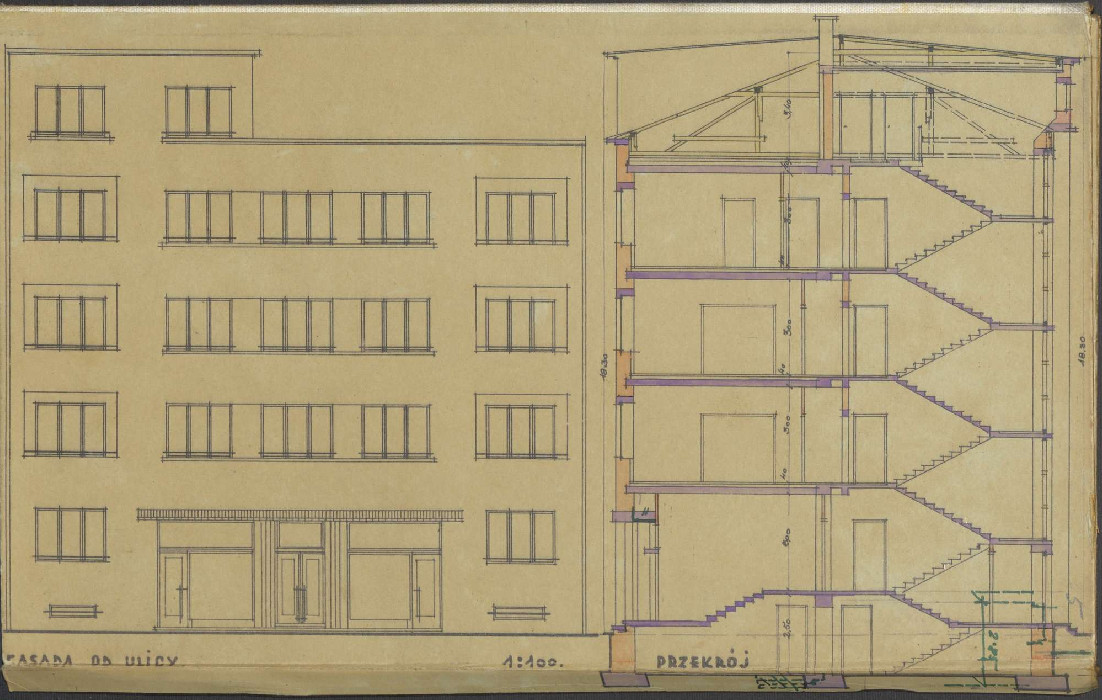
The building has several floors and consists of five- and four-story sections located in a row of buildings on the street. The foundations and walls are made of brick. All floors, foundation pads, and stairs are made of reinforced concrete (according to Salomon Keil's drawings from 1936). The attic floor and the roof truss structure are made of wood. The roof is covered with tin.
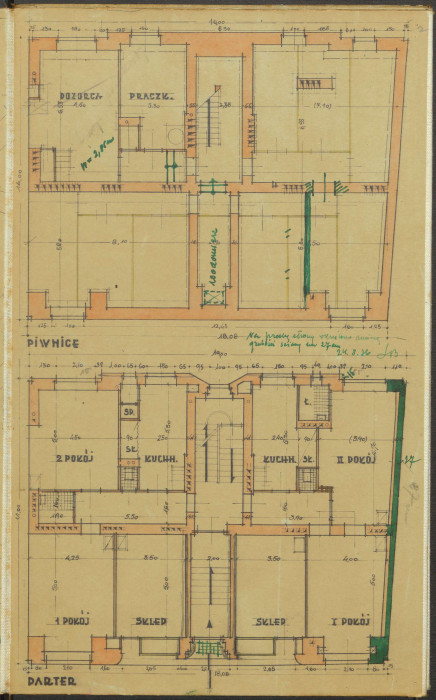
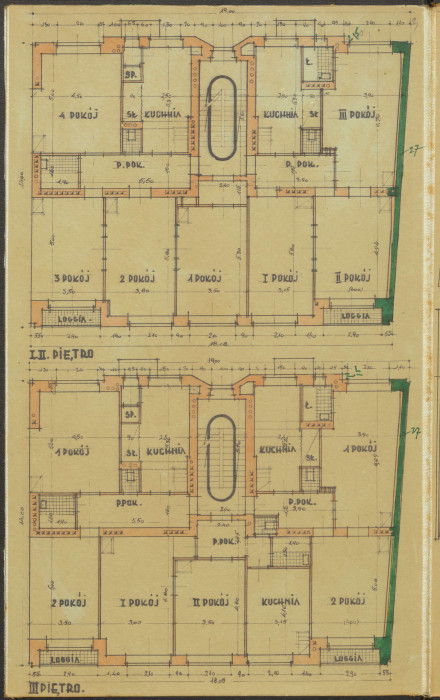
The building is rectangular in plan. The main entrance is located in the center of the façade and leads to a hallway with several steps. From there, there is access to two apartments. The main staircase is a typical two-flight one. According to the original 1936 design, there are three two-room apartments on the second and third floors; on the fourth floor, there is a four-room apartment and a three-room one; on the ground floor, there are two-room apartments, as two rooms are intended for shops. On the fifth floor, there is a two-room apartment and a studio apartment, consisting of a room, a bathroom, and a small hallway. All of them have toilets and separate bathrooms, kitchens with pantries, most of which have niches for maids. The original plan was insignificantly changed during the construction in early 1937: the apartment on the fifth floor was built without a maid's niche but with a pantry; on other floors, the size of the toilets was adjusted. The basements were intended to house a caretaker's room, a laundry room, and storage rooms.
The façade was designed to be symmetrical, but the five-story part of the building deviates from symmetry by two windows. The main entrance is located in the center, and display windows covering the entire height of the premises were designed on both sides. The three openings are united by a common cornice at the top.
On the second to fourth floors, the three central windows are compositionally united by a common cornice at the bottom. On the outer axes, there are loggias with brick fences and metal railings.
People
Salomon Keil (1884–?) — an architect who designed
the building.
Lazar Kalisch — a merchant who traded in fish and
canned goods, owner of the building and land in 1935–1939.
Sara Perla Schapira, married name Kalisch (recte Schlumer)
— the founder of a canned fish shop.
Mojżesz Dawid Kalisch (recte Schlumer) — a representative of the canned fish shop.
Zenobiusz Kopystiański (1871–1957) — a notary in Lviv.
Józef Pawłowicz — a master of law and an employee
of a notary office.
Joachim Tisch, probably Józef Joachim Tisch (1883–?) — an architect and builder, owner of the
undeveloped plot of land in the interwar period until 1935.
Sources
- Державний архів Львівської області (ДАЛО) 2/1/3361. URL: https://e.archivelviv.gov.ua/file-viewer/230140#file-1350021
- Chwila, 1926, Nr. 2765, s. 4.
- Chwila, 1933, Nr. 5255, s. 6.
- "Wolne posady", Chwila, 1939, Nr. 7252a, s. 16.
- Polska zbrojna. Wydanie specjalne: 1918 – 1933. Na szlakach gospodarczych piętnastolecie, 1933, s. 745.
- Przegląd prawa i administracyi, 1903, z. 12, s. 107.
- "Mieszkania", Przegląd realności i mieszkań, 1937, Nr. 50, s. 1
- Rocznik polskiego przemysłu i handlu, 1930.
- Zbiór ogłoszeń firmowych trybunałów handlowych: stały dodatek do Przeglądu prawa i administraji, 1926, Nr. 4/6, 63.