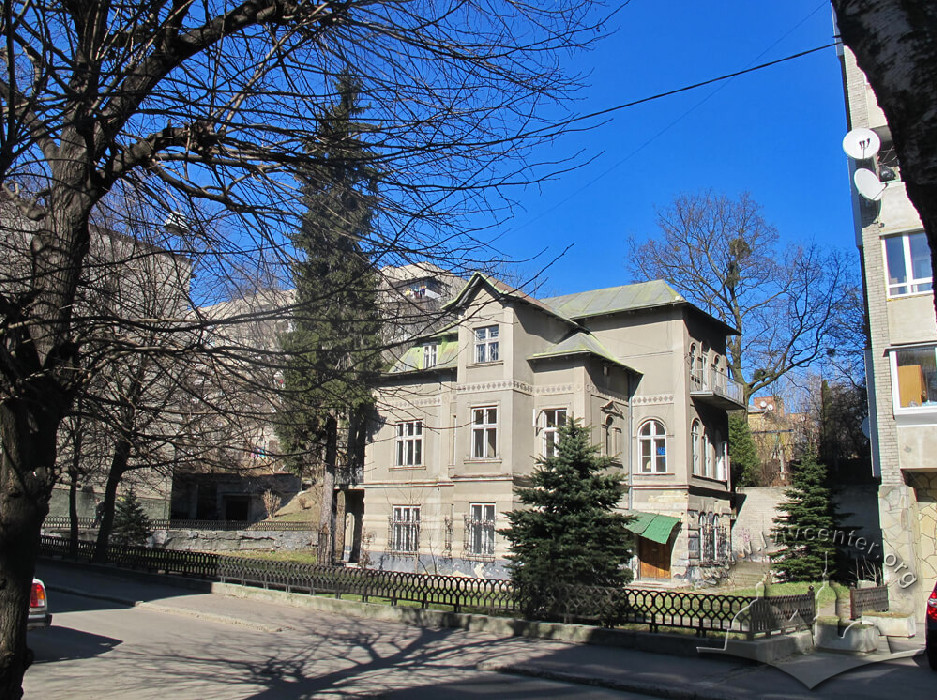
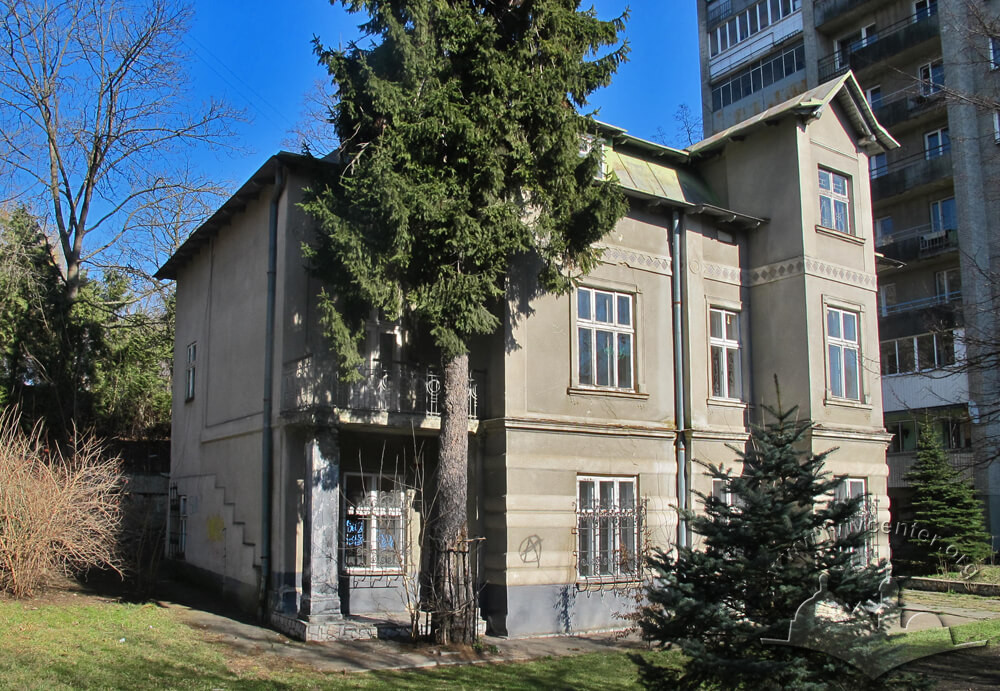
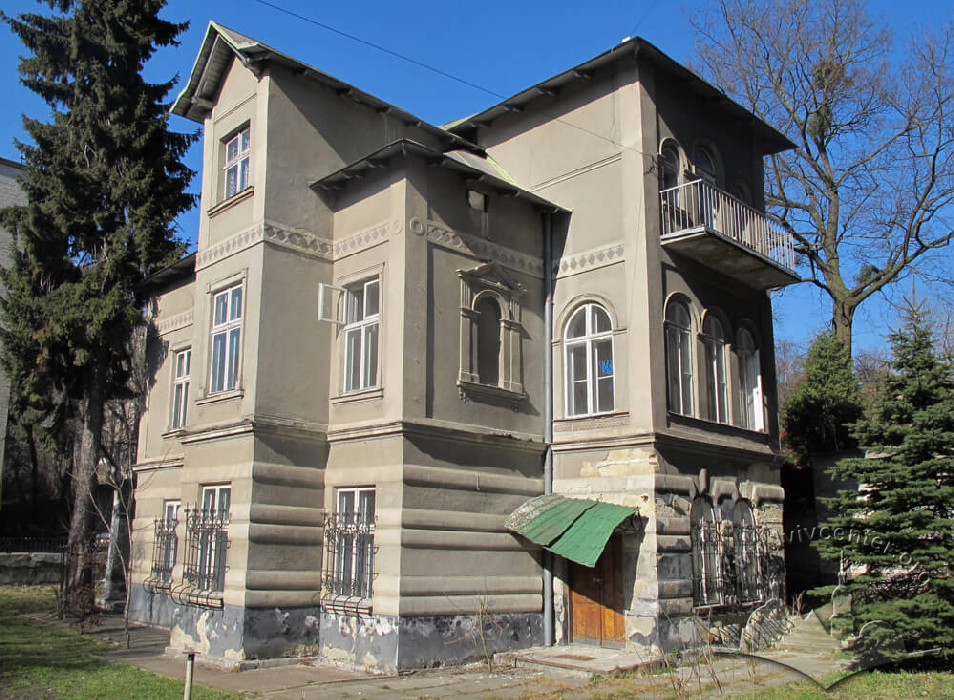
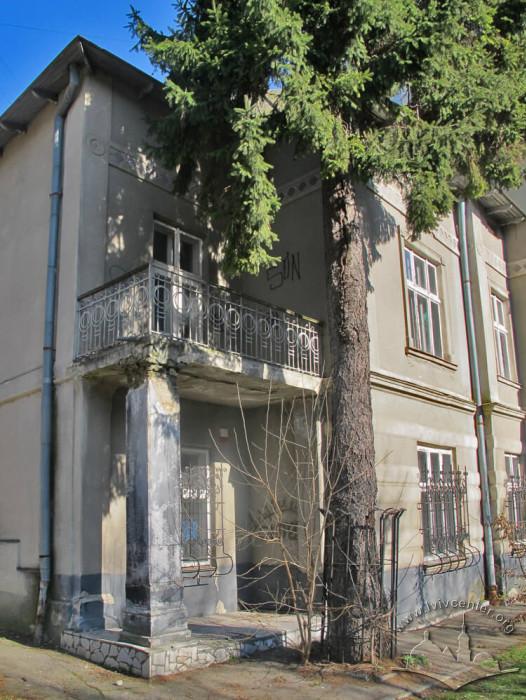
Vul. Henerala Chuprynky, 96 – office building (former Podolianka villa) ID: 2353
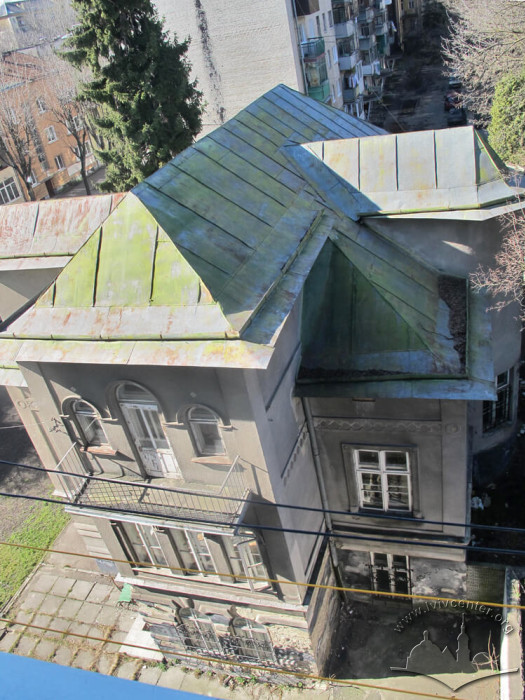
The former "Podolanka" Villa was the private residence of Michał Kowalczuk — a renowned Lviv architect, restorer, and sculptor of Ukrainian origin. He constructed the villa to his own design between 1907 and 1908. The building stands as a prime example of the Ukrainian national style in early twentieth-century Lviv architecture.
Story
1908 — the building was constructed.
1912 — the foundation was installed.
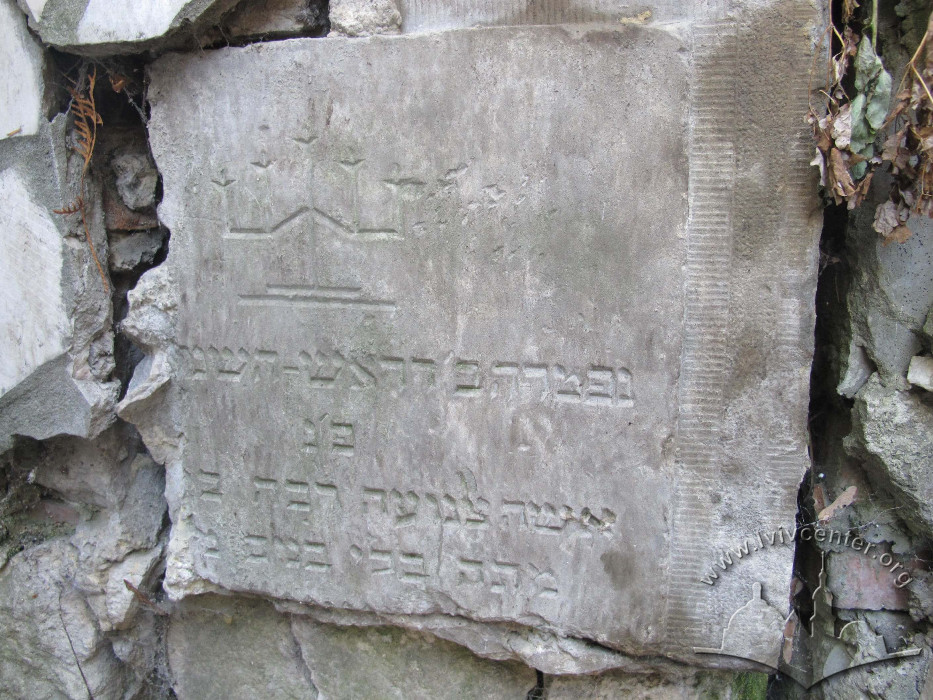
1950s — the original tile roof was replaced with galvanized sheet metal, and the foundation was repaired and clad with repurposed Jewish headstones.
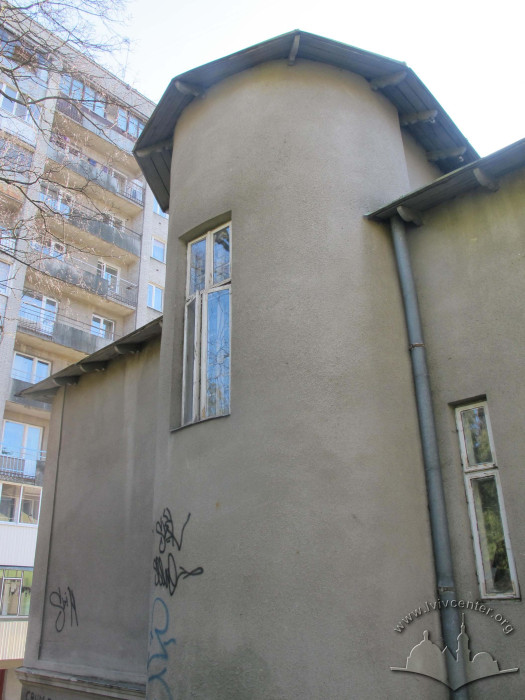
1970s — the façades were finished with plaster, a style locally known as "shuba."
Early 1990s — the building was converted from a residence into an office. This involved interior renovations (installation of suspended ceilings and partitions, and the replacement of several doors). Exterior work included adding a canopy over the entrance, enclosing the plot with a metal fence on a brick foundation, and reinforcing the hillside retaining wall with irregular marble tile cladding and landscaping.
The building is situated in the upper section of vul. Henerala Chuprynky, which lies west of the city center and connects vul. Stepana Bandery to vul. Rudnytskoho. The first known name of the street's upper section was ul. Standowska, derived from the Scholz-Stanczlowicz family — a prominent Lviv burgher family that acquired land there as far back as the sixteenth century, which was then known as the Stanczlowka jurisdiction. In 1863, the street was recorded as ul. Krzyżowa. By 1910, its name was changed to honor Andrzej Potocki, the Governor of Galicia. During World War II, the successive occupying authorities renamed the street after their own figures: Pushkina (December 1940), Potockiego (August 1941), Siegfriedstrasse (May 1942), Pototskoho (July 1944), and Pushkina (December 1944). In 1996, the street was renamed vul. Henerala Chuprynky in honor of the Ukrainian political figure Roman Shukhevych, a General-Khoruzhnyi of the UPA (pseudonym: Taras Chuprynka).
In 1900, Michał Kowalczuk, a Lviv architect of Ukrainian descent, purchased a plot of land (conscription number 182 ¼) at what was then ul. Krzyżowa 54 — today vul. Henerala Chuprynky 96.
The purchased plot consisted of four parcels, numbered 2684, 2685, 2686, and 2687. It was situated on a fairly steep slope, stretching from southeast to northwest (along vul. Konotopska Street, which was later laid out at the bottom of the slope). The adjacent plot, No. 2688, which sat significantly higher, belonged to the Skibiński family. A buttress 3.5–3.7 meters high ran along the boundary of these plots. In the southwestern portion of the acquired land, there had long been a small pond that collected groundwater and surface runoff. Before building the villa, Michał Kowalczuk fenced off his plot from ul. Krzyżowa with wooden pickets along the designated building line and constructed a timber framed shed to store building materials. In 1907, he designed his own villa, named "Podolianka," and that same year he constructed the house along with a stable, a gatehouse, and a room for the groom. In 1908, on Saint Nicholas Day, he submitted an application to the city council for an occupancy permit for the completed residence. The architect skillfully worked the steeply sloped plot where the villa stood, leveling the ground. To prevent soil from sliding down from the higher adjacent plot (No. 2688), he reinforced the slope with a foundation in 1912. The finished villa was partially two stories and partially three stories tall, topped with a tiled roof. In the early 1920s, ul. Boremelska (Konotopska) was laid out across plots No. 2682 and 2683 alongside Kowalczuk's property, connecting Mączyńskiego and Potocki streets (now Yefremova and Henerala Chuprynky streets). Kowalczuk lived in the villa until the end of his life.
In the postwar period, the villa was occupied by several families. During a renovation, the tiled roof was replaced with galvanized sheet metal, which diminished the character of the architectural design. In the 1960s, the large plot stretching along Konotopska — formerly owned by Michał Kowalczuk — began to be developed with high-rise buildings: one was erected in 1969 along vul. Pushkina (Henerala Chuprynky), obscuring the villa, while another was built along vul. Konotopska. At that time, there were also attempts to demolish the "Podolianka" villa to build an apartment complex in its place. However, this plan was thwarted by the architect Yaroslav Novakhivskyi, son of the prominent Ukrainian artist Oleksa Novakhivskyi. It was then that the villa was finished with roughcast stucco. It was likely during those same repairs that the foundation was patched with fragments of stone tombstones — matzevot — taken from one of Lviv's destroyed Jewish cemeteries.
Architecture
The villa is set back within a small square plot, enclosed on three sides by a low metal fence and at the rear by a retaining wall that stabilizes the excavated slope. Its main façade faces vul. Konotopska, while a Soviet-era high-rise apartment building obscures it from vul. Henerala Chuprynky.
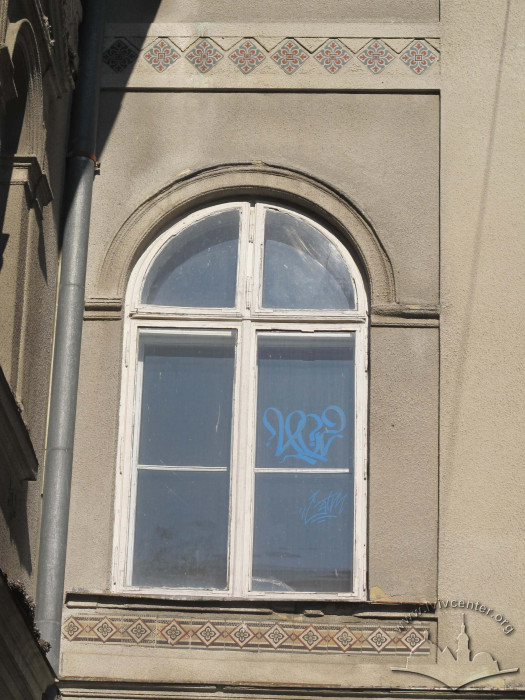
The villa is a two-story brick structure with a antresol and cellars, featuring a complex layout. It is finished with plaster and topped by an intricate roof — partially mansard — currently clad in sheet metal (originally tile). Its stylistic design reflects Modern influences combined with elements of traditional architecture. Stylized architectural details include: decorative window trimmings, ceramic tile inserts, exposed wooden roof eaves, secessionist-style metalwork on the balcony railings. The building's architectural form is defined by a composition of varying volumes, highlighted by diverse window openings — ranging from double- and triple-pane rectangular windows to arched ones, all featuring wooden carpentry. The ground floor is rusticated and accented by a modest cornice, while a decorative band of ceramic tiles runs above the windows on the second floor.
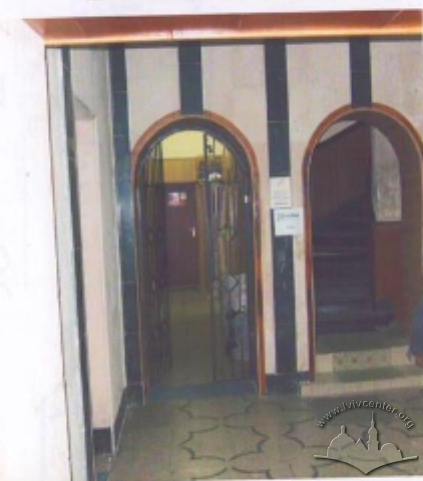
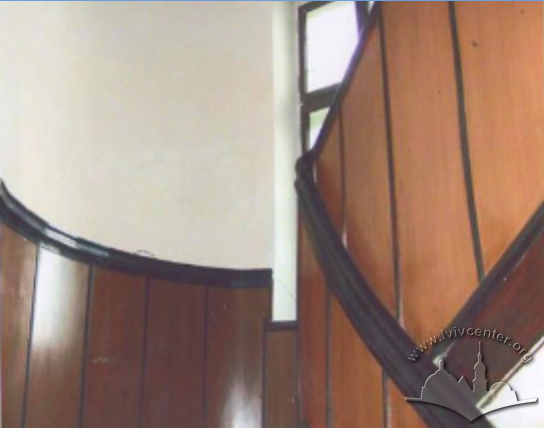
The interior retains its original wooden staircase and paneling, along with walls decorated with vertical strips of black marble. The door panels are finished to imitate the appearance of curly birch, and the floors are constructed with wooden ceilings.
The building stands as a quintessential example of the Neoukrainian style in early twentieth-century Lviv architecture.
People
Andrzej Potocki — Governor of Galicia.
Michał Kowalczuk — an architect of Ukrainian descent, restorer, and historian. He was the author of numerous works on the history of sculpture and architecture, the most significant being "The Builders' Guild in Lviv During the Polish Era until 1772" (Pol. "Cech budowniczy we Lwowie za czasów polskich do r. 1772").
Oleksa Novakhivskyi — a prominent Ukrainian artist.
Taras Chuprynka (pseudonym of Roman Shukhevych) — a Ukrainian political figure and General-Khoruzhnyi of the UPA.
Scholz-Stanczlowicz family — a Lviv burgher family that, in the sixteenth century, acquired land known at the time as the Stanczlowka jurisdiction.
Yaroslav Novakhivskyi — an architect and the son of Oleksa Novakhivskyi.
Sources
- Державний архів Львівської області (ДАЛО) 2/1/2610.
- ДАЛО 2/41/7.
- Центральний державний історичний архів у Львові (ЦДІАЛ) 186/8/629.
- Grabowski W., Portret artysty na jasnym tle, "Akcent. Literatura i sztuka. Kwartalnik", 2010, №1 (119), 158.
- Lewicki J., Między tradycją a nowoczesnością. Architektura Lwowa lat 1893–1918 (Warszawa, 2005).
- Архітектура Львова: Час і стилі. XIII–XXI ст. (Львів: Центр Європи, 2008).
- Бірюльов Юрій, Вілли архітекторів, "Галицька брама", 2007, № 3-4 (147-148).
- Бірюльов Юрій, Ковальчук Михайло (Міхал), Енциклопедія Львова, Т. 3 (Львів: Літопис, 2010), 304-305.
- Дорош А., Мешканці Нового Світу, "Галицька брама", 2007, № 3-4 (147-148), 16-18.
- Котлобулатова Ірина, Вулиця Генерала Чупринки, "Галицька брама", 2007, № 3-4 (147-148), 35-36.
- Львів. Туристичний путівник (Львів: Центр Європи, 2007).
- Мельник Б., Довідник перейменувань вулиць і площ Львова (Львів: Вид-во "Світ", 2001).
- Мельник І., Львівський Новий світ та південні околиці королівського столичного міста Галичини (Львів: Центр Європи, 2009), 138-139.