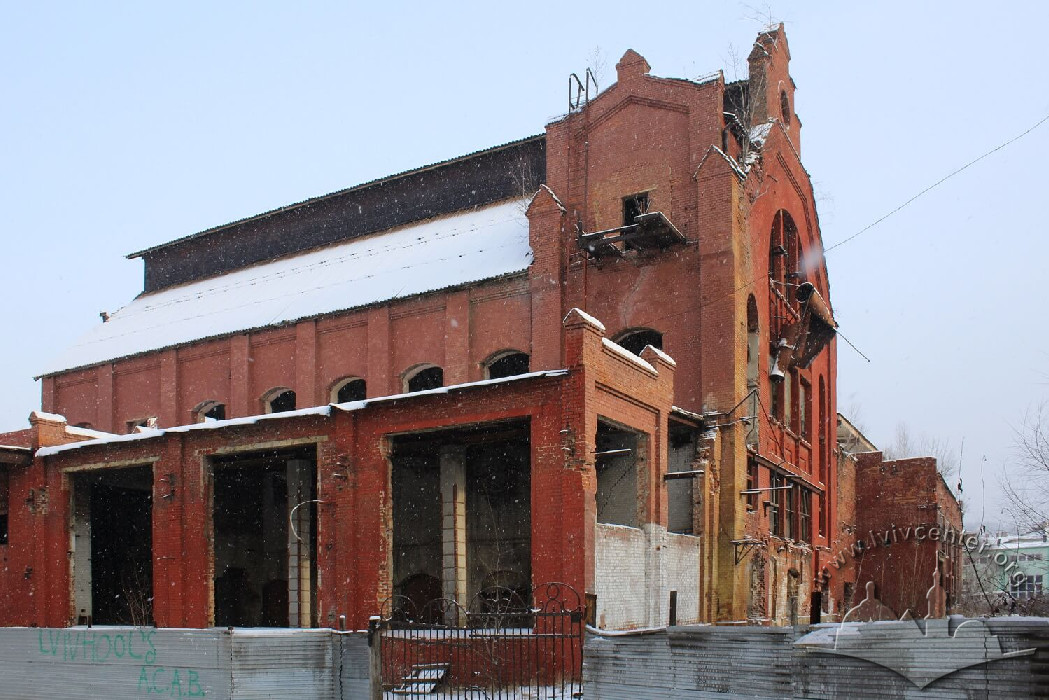
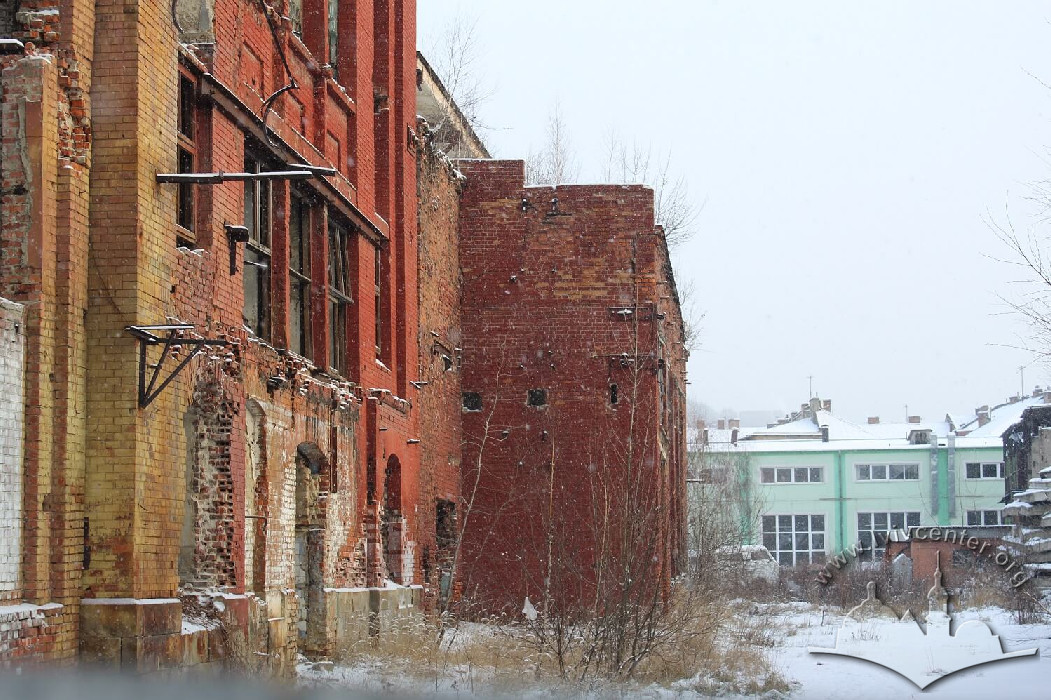
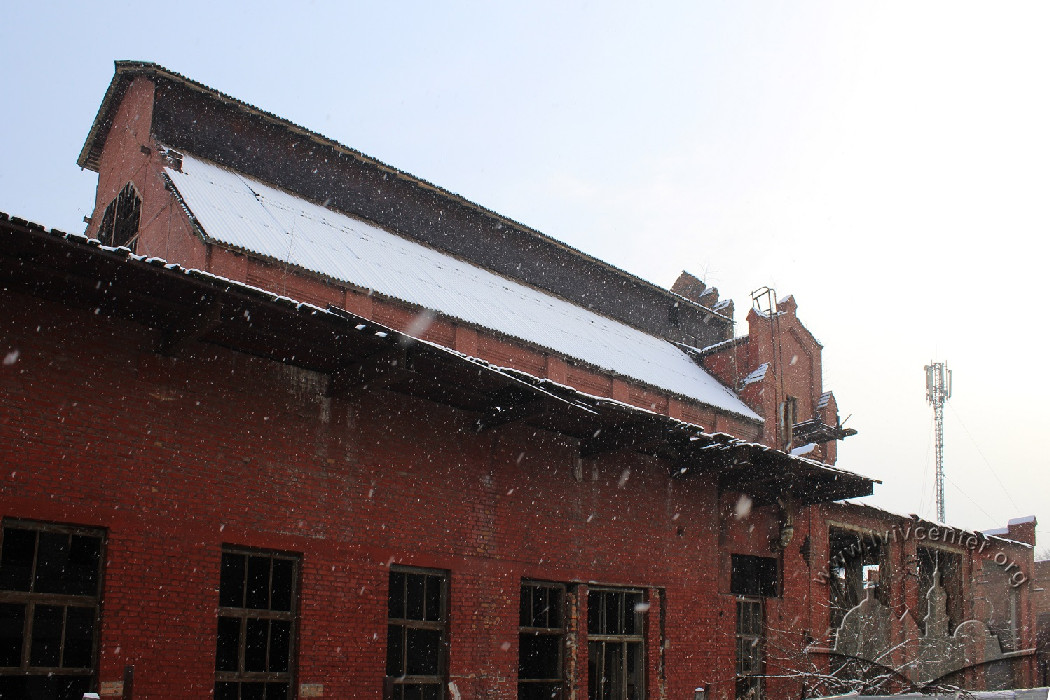
Vul. Hazova, 28 – boiler room of the gas plant (no longer exists) ID: 2461
The area bounded by Dzherelna, Balabana, Kulisha, and Pid Dubom streets was home to the former municipal gasworks, whose purpose was to supply Lviv with gas for street lighting. Until the 2010s, the central building of the factory complex remained intact — a four-story boiler room, probably designed by architects Alfred Kamienobrodzki and Michał Łużecki in the 1890s. The unplastered brick structure was an illustrative example of late the nineteenth century industrial architecture with elements of Neogothic and Neoromanesque styles.
Story
London was the first city to introduce gas street lighting (1807), and this practice subsequently spread throughout Europe. In 1855, the German Continental Gas Company (Ger. Deutsche Continental-Gas Gesellschaft in Dessau, abbreviated as DCGG) was founded in the Saxon city of Dessau. On the company's initiative, a gas plant was built in the city. This organization was responsible for the emergence of similar plants in other cities of Central and Eastern Europe, including Magdeburg, Frankfurt an der Oder, Potsdam, Warsaw, Krakow, and Lviv.
As early as 1856, a contract was signed between this company and the representative office of the royal capital city of Lviv for the construction of a gas plant and the installation of gas street lighting. For the construction of the complex, the magistrate allocated a plot of land in the Krakow suburb, part of the territory of the old cattle market next to ul. Słoneczna (today vul. Kulisha).
Construction began in 1858, and on September 1 of that same year, the complex was put into operation (ДАЛО 2/4/1021). Initially, it consisted of two large gas storage tanks (gas holders) located next to vul. Dzherelna (no longer preserved); a building for gas distillation and cooling; and an administrative building located on the side of what is now vul. Hazova 28.
From the very beginning, in addition to producing so-called lighting gas from coal, the plant also produced other equally valuable by-products: coke, tar, ammonia, and ammonia spirit.
According to the contract between the Dessau and Lviv companies, the former had the exclusive right to supply gas to Lviv and private individuals for 25 years. In 1883, the contract was extended for another 15 years, and in 1898, the gasworks became the property of the city free of charge. After that, the complex was expanded. According to the project of architects Alfred Kamienobrodzki and Michał Łużecki, new buildings were constructed in a brick style characteristic of the industrial architecture of that time. The decor of these buildings features elements of the Neogothic and Neoromanesque styles (ДАЛО 2/4/1021). In particular, several buildings were erected in the southern part of the enterprise's territory, such as warehouses and a boiler room located behind the administration building. Today, the boiler room most vividly represents the architecture of the former factory (Бірюльов, 2008, 322).
Over the years of its operation, the gasworks complex was repeatedly expanded, enlarged, and modernized. In particular, during the interwar period, the boiler room building was expanded in length by two windows.
The gasworks continued to operate throughout the Soviet era. Numerous additions were made to the site, including several to the boiler room building, and the construction of some new buildings. In May 1961, the Lvivgas trust moved to a new base at vul. Zolota 42, where, after a series of additions and renovations, it continues to operate today.
By the 2010s, the gasworks buildings were no longer used for their original purpose. Specifically, the cooling plant building now houses a restaurant, the purification building was converted into the "Gas Station" entertainment club, and the administration building serves as a bank. Several other structures, including the boiler house, sat vacant and fell into disrepair before eventually being demolished to make way for new residential development.
Architecture
The gas plant was located in a historic suburb north of the center of Lviv, in the quarter between Dzherelna, Balabana, Kulisha, and Pid Dubom streets. Vul. Hazova also runs partially through the quarter. Legal address: vul. Hazova 28. Most of the gasworks buildings are occupied by commercial establishments, banks, restaurants, etc. They are located mainly in the western part of the quarter, directly bordering vul. Dzherelna. To the south lies a glass mirror factory, situated on the site of the former Colosseum Theater, which was destroyed during World War II.
At the beginning of the 20th century, there were already more than twenty buildings of various purposes on the territory, including an administrative building, coke tanks, gas holders, staff houses, stables, a chemical laboratory, shops, boiler rooms, and other auxiliary premises. Most of the buildings were clustered in the center of the site near the gas holders to facilitate their maintenance. The administration and staff buildings were located in the eastern part of the site, while the gas holders themselves were situated directly along vul. Dzherelna.
The buildings were constructed in a brick style, i.e., with exposed brickwork, featuring decorative Neogothic elements. The administrative building in the eastern part of the site at vul. Hazova 28 is a striking example of the Neogothic style. The building is a three-story structure with two porches on the main façade and one porch each on the northern and western façades, which are plastered. In recent years, reconstruction has been carried out, in particular, an attic floor has been added. Today, a bank operates here.
Another equally striking example of Neogothic architecture was the former cooling plant building at vul. Dzherelna 20. The main façade of the building is symmetrical and accentuated in the center by a gable with open brickwork. As a result of the renovation, the façade was plastered, the entrance group was reconstructed, and balustrades were installed, which significantly distorted the authentic appearance of the building. These days, the building houses a restaurant.
Of all the gasworks buildings, only the former boiler room of the plant, built probably in the 1890s, has been preserved in its authentic form until the 2010s, albeit with numerous later additions from the Soviet era. According to the original design, the building was a large rectangular workshop measuring 33 by 16 metres. The building's main façade faced the southern part of the facility's grounds. The façade was symmetrical, with a semi-basement faced with sandstone. The main entrance to the building was located on the central axis of the façade, which was also accentuated by a large three-part, three-tiered window topped with a semicircular arch. Smaller windows were symmetrically placed on both sides, the upper ones also being semicircular. The façade was topped with a gable featuring a round window in the middle.
The western façade of the building had a longitudinal row of eight windows featuring arches and nine pilasters. Above the outer window (on the south side) was a gable with a window opening of a similar shape. The eastern façade repeated the composition of the western one, but excluding the gable. The northern façade was symmetrical, structurally supported by a metal timber frame, and had two large windows located one above the other. The upper one was trapezoidal in shape, and the lower one — rectangular. The walls of the building were brick. The exterior walls were double-layered, with the outer layer made of hollow facing bricks and the inner — of solid bricks.
During the Soviet period, the building was reconstructed: a prefabricated reinforced concrete floor was installed on four metal columns situated on the central axis of the building; the roof covering was replaced with corrugated asbestos-cement slabs on metal trusses. In addition, a number of extensions were constructed. Among them is a single-story, rectangular workshop on the west side built in the style of Soviet industrial architecture. The south façade of the workshop is asymmetrical, with two large windows that occupy almost its entire surface. The western façade is also asymmetrical, faced with brick, it features a longitudinal row of ten small and three large windows. The northern façade has two small windows.
In addition, a three-story block for administrative premises has been added to the north of the building. Its northern façade is asymmetrical, with three window axes. The eastern façade has a complex configuration due to two protruding volumes: single-story high (technical rooms) and three-stories high (stairs). The main building block consists of six window axes. The technical section includes three doorways on its northern side, while the stair tower features a large, three-story window on its eastern face.
A large workshop was also added on the eastern side. The southern façade of the eastern building is brick, built in the style of typical Soviet industrial architecture, featuring three large windows and two doorways. The straight line of the façade is interrupted by the displacement of the building. The façade borders the oldest building to the west and another Soviet extension, which looks like a large workshop, to the east. The northern façade duplicates the windows of the southern one and lies in the same plane.
By the 2010s, the boiler house was no longer in use and had fallen into a state of total disrepair. Around 2020, it was demolished.
People
Alfred Kamienobrodzki — Lviv architect.
Michał Łużecki — Lviv architect, director of the construction department of the Lviv magistrate.
Adam Teodorowicz — renowned engineer, director of the gasworks in 1894–1920.
Sources
- Державний архів Львівської області (ДАЛО) 2/4/1021.
- Архітектура Львова: Час і стилі. ХІІІ–ХХ ст., ред. Ю. Бірюльов (Львів: Центр Європи, 2008).
- http://www.lvivgaz.lviv.ua — сайт публічного акціонерного товариства "Львівгаз".
- http://uk.wikipedia.org/wiki/Газифікація_Львова
- https://www.deutsche-digitale-bibliothek.de/item/T66IJU7LOYBAUIADY37HS2ATP74FS6FT