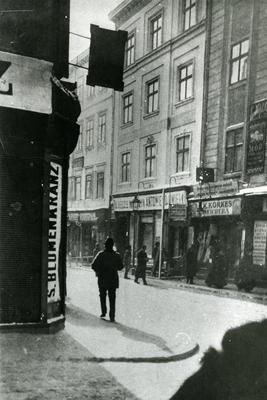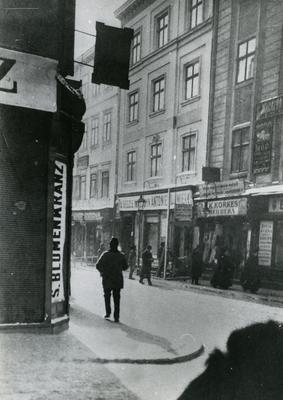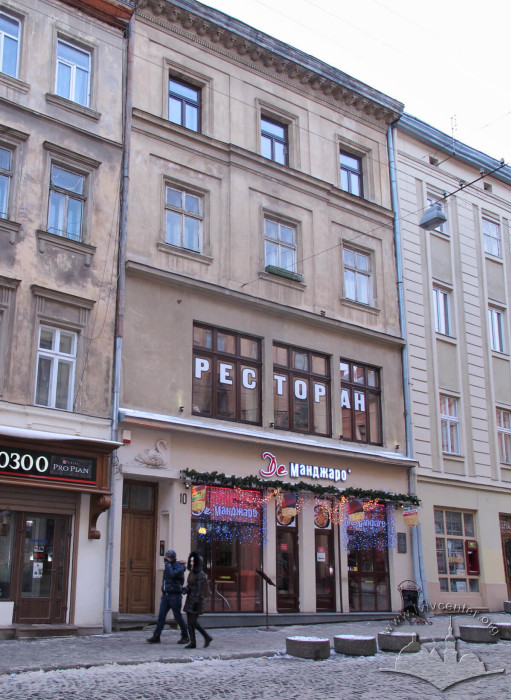
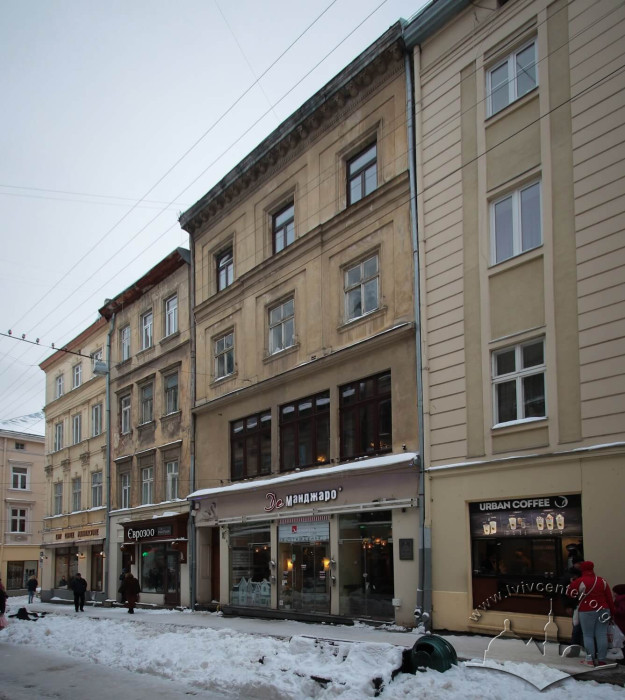
Vul. Halytska, 10 – residential building ID: 2325
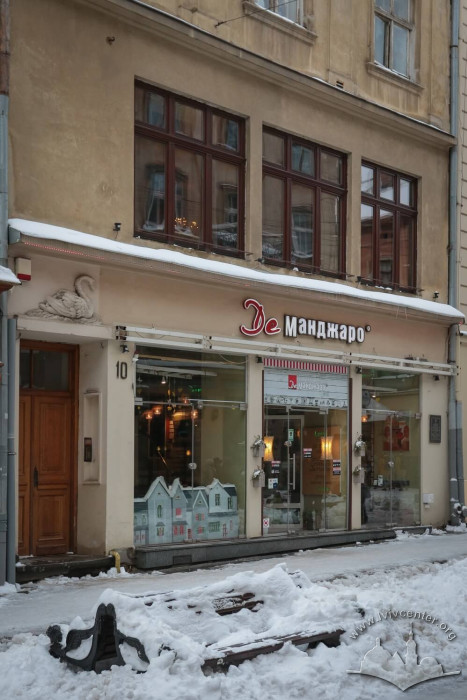
The townhouse (old conscription no. 21, new no. 17) was built by the Bem family in the late eighteenth century in the Late Baroque style, utilizing the foundations of the former Pukarzewski Townhouse. By Decree No. 442 of the Council of Ministers of the Ukrainian SSR (dated September 6, 1979), the townhouse was included in the National Register of Monuments under protection number 1283. As of 2014, the ground floor houses the "De Mandjaro" fast-food restaurant.
Story
Sixteenth century — construction of a three-story stone townhouse.
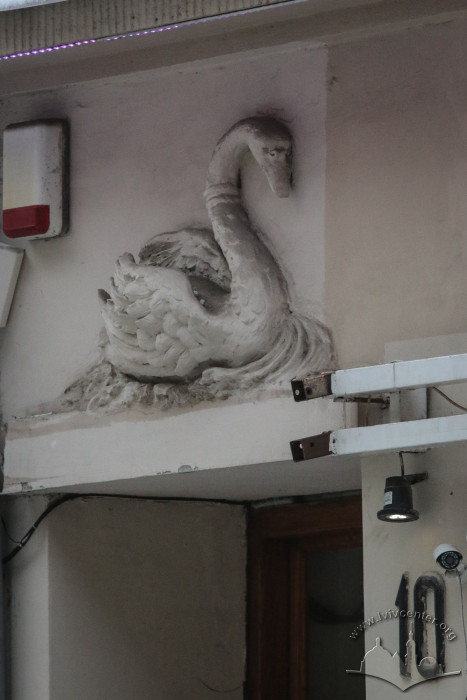
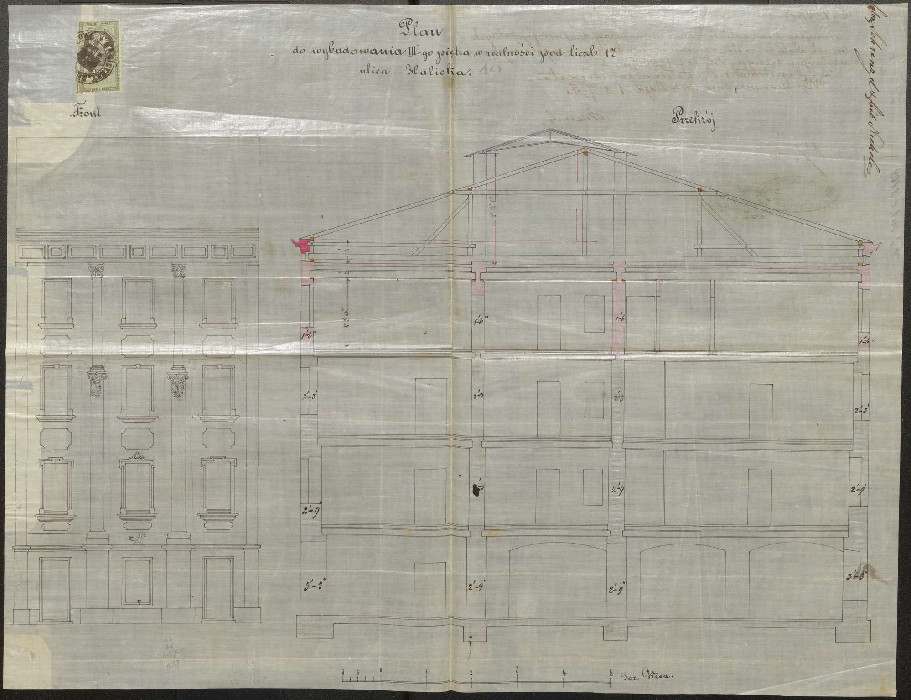
Late eighteenth century — the Bem family constructs a new three-story Late Baroque townhouse on the old foundations and installs a swan sculpture.
Late eighteenth century — construction of a courtyard wing.
1850 — a three-story service wing was built.
1875 — addition of a fourth floor to both the main building and the service wing.
1894 — renovation of the shop windows; the swan sculpture is damaged.
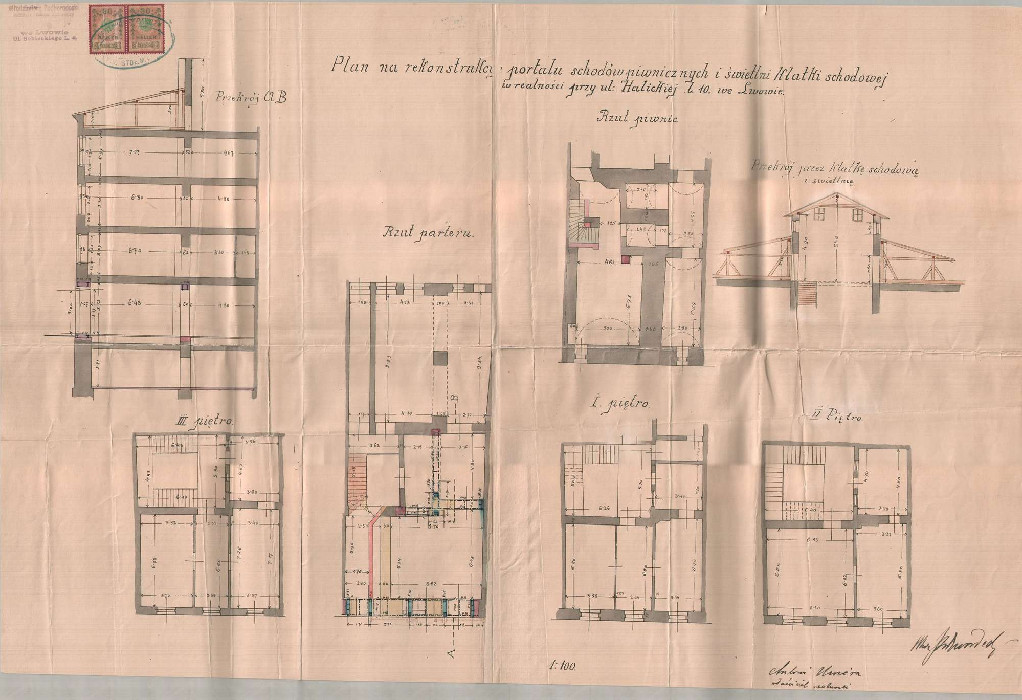
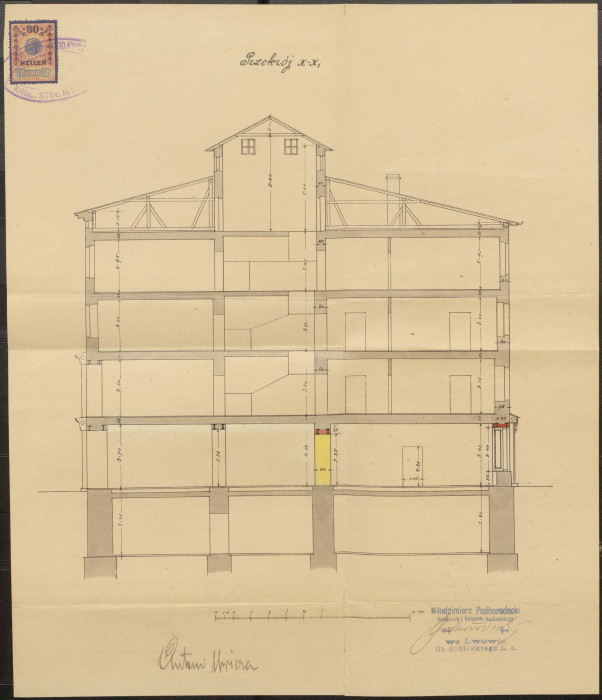
1909 — renovation of shop windows, involving the removal of a ground-floor wall and the installation of a skylight over the staircase (architect – Włodzimierz Podhorodecki).
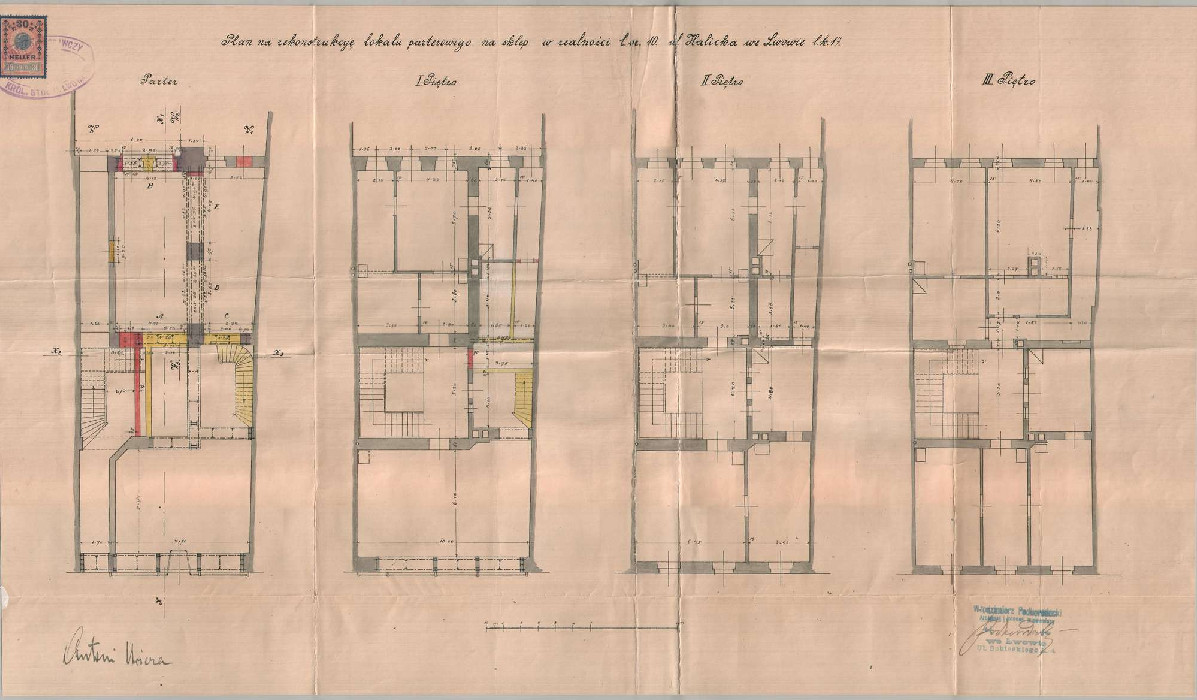
1912 — major reconstruction giving the façade its modern appearance; new stairs are installed from the ground-floor shop to the second floor, and the swan sculpture is restored (architect — Włodzimierz Podhorodecki).
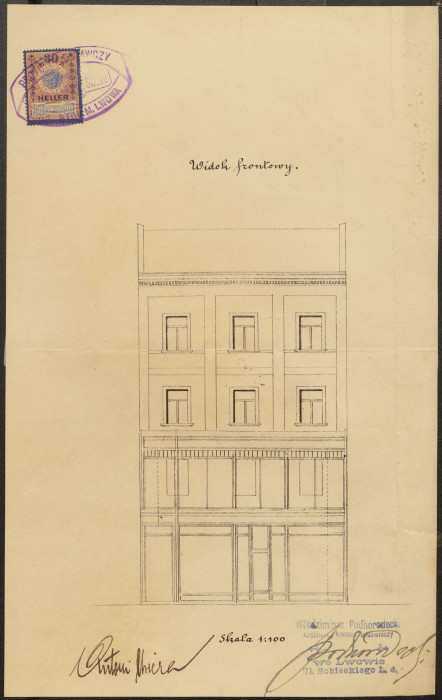
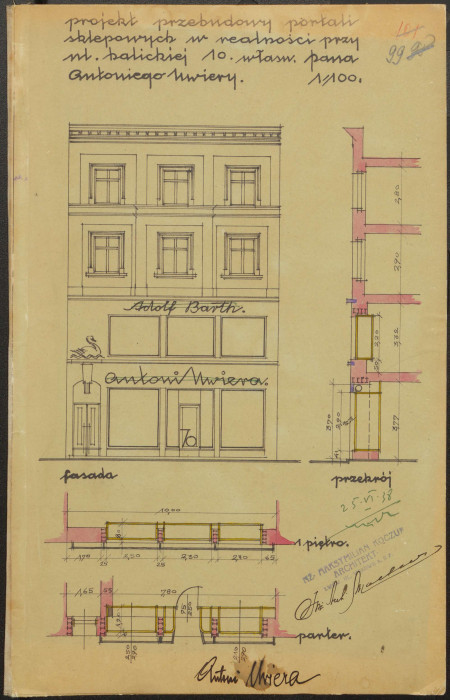
1938 — modern shop windows are installed (architect — Maksymilian Koczura).
Early 2000s — the ground floor is converted into the "De Mandjaro" fast-food restaurant.
The plot at no. 17 (old no. 21) has been developed since the city was first laid out under Magdeburg Law, though the original structure was likely wooden. A townhouse was erected here in the sixteenth century, which, according to a 1712 register, stood three stories tall. While it had many owners, it became known by two primary names: the Pukarzewski (seventeenth century) and the Bem Townhouse (eighteenth century). It was also known as "Under the Swan" after the sculptural emblem above the entrance. In 1600, the building was home to Lawrenty Lojecki, an organist for the Roman Catholic Cathedral, after whom the house was briefly named. Later owners included Jakób Niewczas (1636–1655) and the Pukarzewski family. By 1662, it was held by the barber surgeon Łukasz Pukarzewski, and from 1686 until the early 1700s, by his son, the Lviv assessor Eustachiusz Pukarzewski. In 1696, Franciszek Ozgiewicz and his wife, Margareta (née Pukarzewskich), bequeathed the house to the Hospital of the Holy Spirit. From 1702, part of the building became the property of Szymon Ziajkiewicz and Anna Pukarzewski. In 1710, Ziajkiewicz and Ivan Kovalskyi ceded their house to the metropolitan Latin canon Reingold Zivert. By 1760, the property passed to the assessor Wojcech Bem and his wife, Joanna née Venino, whose family name would define the building for decades.
In 1798, the widowed Joanna Bem and her children sold the Bem Tenement (conscription no. 17), which had been recently rebuilt, to Antoniusz Fryk for 46,000 zł. At that time, a courtyard wing, which abutted the Zarytskyi walls, was still under construction; behind it stood the house of Michał Budziński.
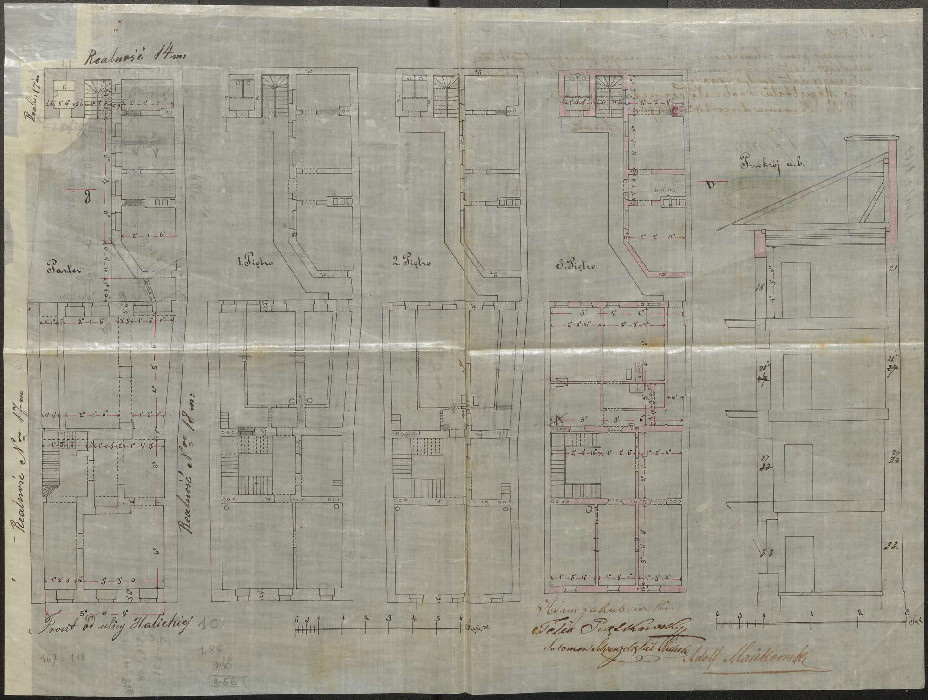
Major changes to the building's spatial and floor-plan layout took place during the nineteenth century. In 1850, a three-story service wing was constructed. A subsequent reconstruction followed in 1875, when a fourth story was added to both the main building and the service wing. The surviving plans for this addition — which remain unsigned by the architect — were approved on May 24, 1875. According to these drawings, the original three-story house was designed in the Late Baroque style, featuring pilasters in the Zopfstil (Ger. Zopf, meaning "braid"), a hallmark of that era.
During a renovation of the shop windows in 1894, the new owner damaged the sculptural depiction of a swan on the façade. This prompted an intervention by Conservators Circle (Pol. Grono Konserwatorów), represented by historian Władysław Łoziński, who demanded the restoration of this house emblem or sign. The next renovation of the shop windows, which involved removing a ground-floor wall and installing a skylight over the staircase, took place in 1909 according to a design by architect Włodzimierz Podhorodecki. A final reconstruction that gave the façade its current appearance was carried out in 1912 by the same architect. A new staircase was installed, leading from the ground-floor shop to the second floor. Conservators Circle consented to the façade's reconstruction on the condition that a photograph of the original façade be submitted to the city archives, the "Swan" sign be restored, and the remnants of the original sculpture be transferred to a museum for preservation. For preservation purposes, it was proposed that the window trimming from the second floor be relocated to the third floor. The shop windows reached their current form in 1938, based on a design by architect Maksymilian Koczura.
As of 1910, the ground floor of the townhouse was home to Robert Tomnicki's restaurant, while the courtyard housed the atelier of Kraków-based ladies' tailors Tadeusz Węglarski and Józef Dadej. The second floor featured the meeting hall of the Lviv carpenters' guild and their health insurance fund. Residents of the building included music teacher Ida Danek and her husband Jan Danek, a business executive; master tiler Józef Danek; tailor Andriy Kaznovskyi; master stonemason Karol Romański; Jędrzej Winnicki, a court usher of the governor's administration; merchant Salomon Wischnowitz; attorney Edmund Wolken; Karolina Domańska; and Marya Szulz.
During the interwar period, the ground floor became home to Schrencel's ladies' hat atelier. In the Soviet era, it functioned as a fashion atelier during the 1950s, and from the 1960s onward, as the "Maliatko" shop. In the early 2000s, the ground floor was repurposed to house the "De Mandjaro" fast-food restaurant.
Architecture
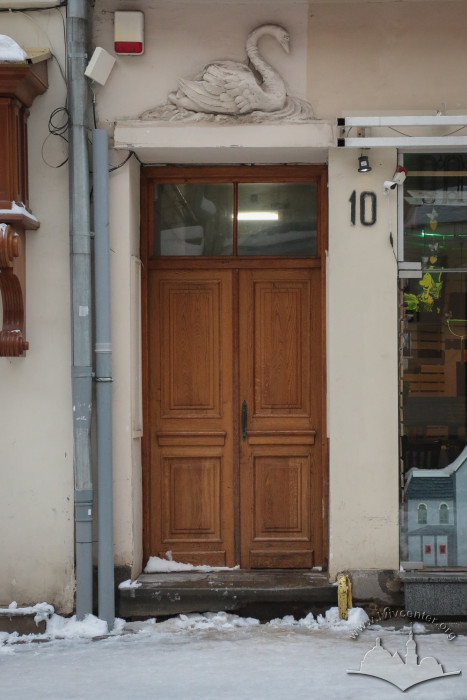
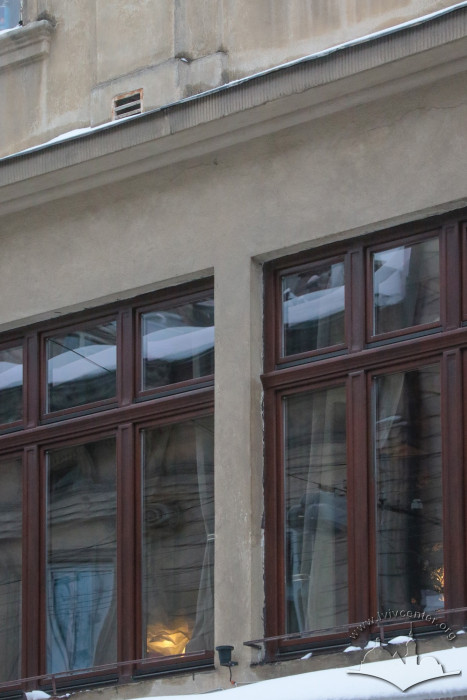
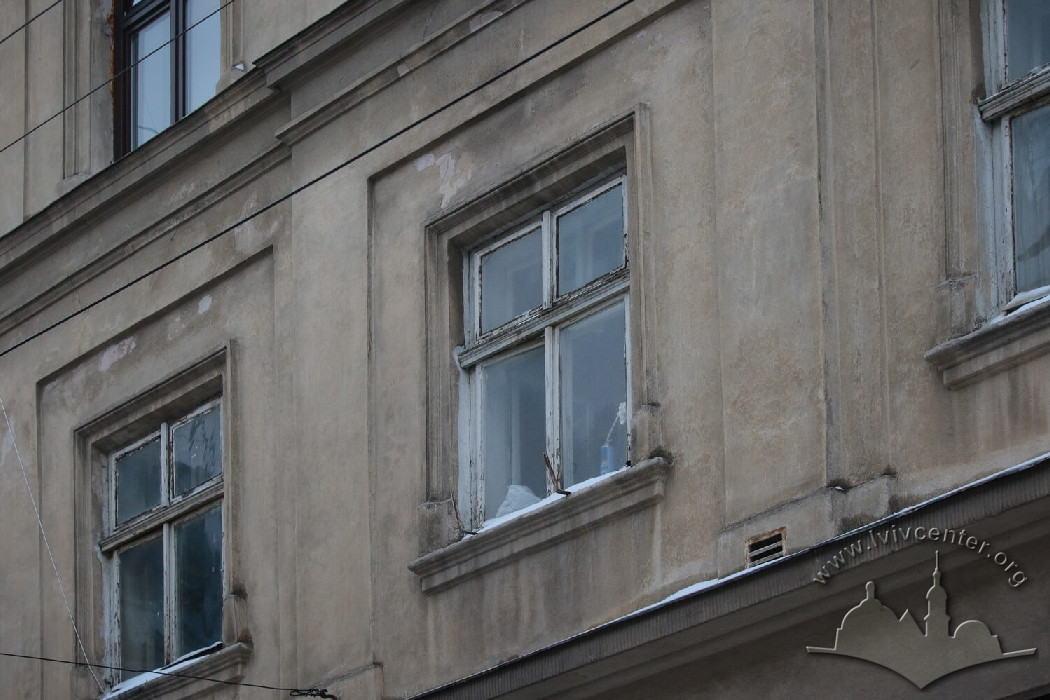
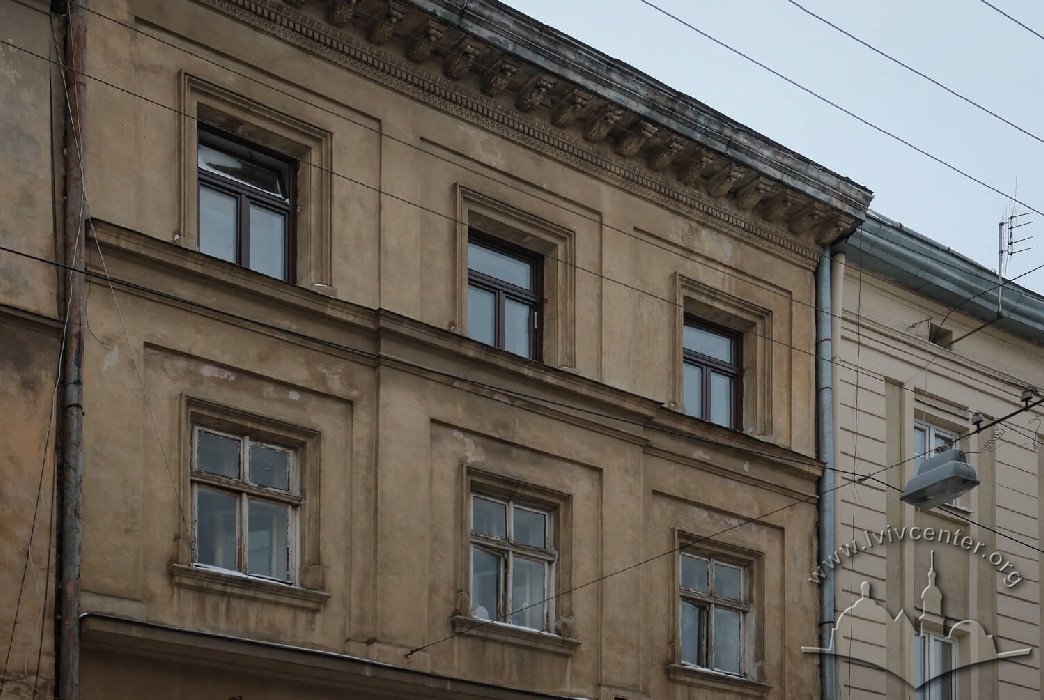
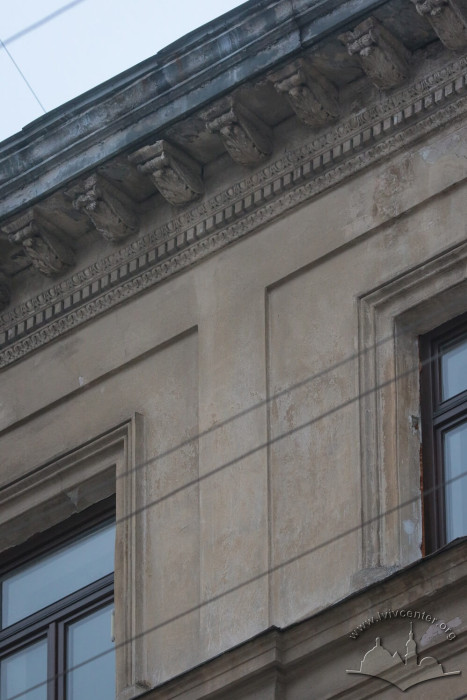
The building is four stories high with three axes. The horizontally divided façade is topped with an elaborate cornice adorned with dentils and corbels, while the upper two stories are decorated with lesenes. The entrance is offset to the left and is surmounted by a sculptural depiction of a swan, placed in the central position on the 1895 architectural plans. Internally, vaulted ceilings have been preserved within the ground-floor rooms and the cellar.
People
Andriy Kaznovskyi — tailor who lived in the townhouse in the early twentieth century.
Anna Ziajkiewicz (née Pukarzewskich) — co-owner of the property and wife of Szymon Ziajkiewicz.
Antoniusz Fryk — owner of the townhouse from 1798.
Władysław Łoziński — polish writer and historian; author of influential works such as "Prawem i lewem", "Patryciat i mieszczaństwo", and "Malarstwo na Rusi".
Wojcech Bem — owner of the townhouse from 1760 and the namesake of the building.
Włodzimierz Podhorodecki — architect responsible for the 1909 skylight design and the 1912 façade reconstruction.
Edmund Wolken — attorney who resided in the building in the early twentieth century.
Eustachiusz Pukarzewski — Lviv assessor and son of Łukasz Pukarzewski; owner of the townhouse from 1686 until the early eighteenth century.
Jędrzej Winnicki — a court usher of the governor's administration who lived in the townhouse in the early twentieth century.
Ivan Zarytskyi — owner of the neighboring property at vul. Halytska 8.
Ivan Kovalskyi — co-owner of the townhouse during the eighteenth century.
Ida Danek — music teacher who lived in the building in the early twentieth century.
Joanna Bem (née Venino) — wife of Wojcech Bem and owner of the property from 1760; she commissioned the construction of the current townhouse upon its ancient foundations.
Karolina Domańska — resident of the townhouse in the early twentieth century.
Karol Romański — master stonemason who lived in the building in the early twentieth century.
Lawrenty Lojecki — organist of the Roman Catholic Metropolitan Cathedral who resided here in 1600.
Łukasz Pukarzewski — barber surgeon and owner of the townhouse from 1662.
Maksymilian Koczura — architect who designed the 1938 shop window installation.
Margareta Ozgiewicz (née Pukarzewskich) — co-owner of the building and wife of Franciszek Ozgiewicz.
Marya Szulz — resident of the townhouse in the early twentieth century.
Michał Budziński — owner of the neighboring house at vul. Staroievreiska 6a, which abutted the property from the rear.
Pukarzewski family — Lviv burghers and owners of the townhouse starting in 1655.
Reingold Zivert — Metropolitan Latin Canon and owner of the property from 1710.
Robert Tomnicki — restaurant owner.
Szymon Ziajkiewicz — co-owner of the townhouse from 1702.
Salomon Wischnowitz — merchant who lived in the building in the early twentieth century.
Tadeusz Węglarski — owner of a Kraków-based ladies' tailoring atelier that operated in the building's courtyard.
Franciszek Ozgiewicz — co-owner of the property from 1696.
Schrencel — owner of a ladies' hat atelier located on the ground floor during the interwar period.
Józef Dadej — co-owner of the Kraków-based ladies' tailoring atelier located in the courtyard.
Józef Danek — master tiler who lived in the townhouse in the early twentieth century.
Jakób Niewczas — Owner of the townhouse from 1636 to 1655.
Jan Danek — Business executive who lived in the building in the early twentieth century.я
Sources
- Державний архів Львівської області (ДАЛО) 2/1/2109. Справа перейменована: ДАЛО 2/1/1976. URL: https://e.archivelviv.gov.ua/file-viewer/228755#file-836434
- Księga adresowa król. stoł. miasta Lwowa (Lwów, 1913).
- Борис Мельник, Ніна Шестакова, "Кам'яниці Львівського середмістя", Наукові записки. Львівський історичний музей, Випуск XII, (Львів: Новий час, 2008), 133-158.
- Володимир Вуйцик, Leopolitana II, (Львів: Класика, 2012).
- Памятники градостроительства и архитектуры УССР, Т. 3 (Киев: “Будівельник”, 1985), 23.
Citation
Oksana Boyko, Vasyl Slobodian. "Vul. Halytska, 10 – residential building". Lviv Interactive (Center for Urban History, 2014). URL: https://lia.lvivcenter.org/en/objects/halytska-10/