Vul. Halytskoi Armii, 7 – Lion’s Castle Hotel (former villa) ID: 427
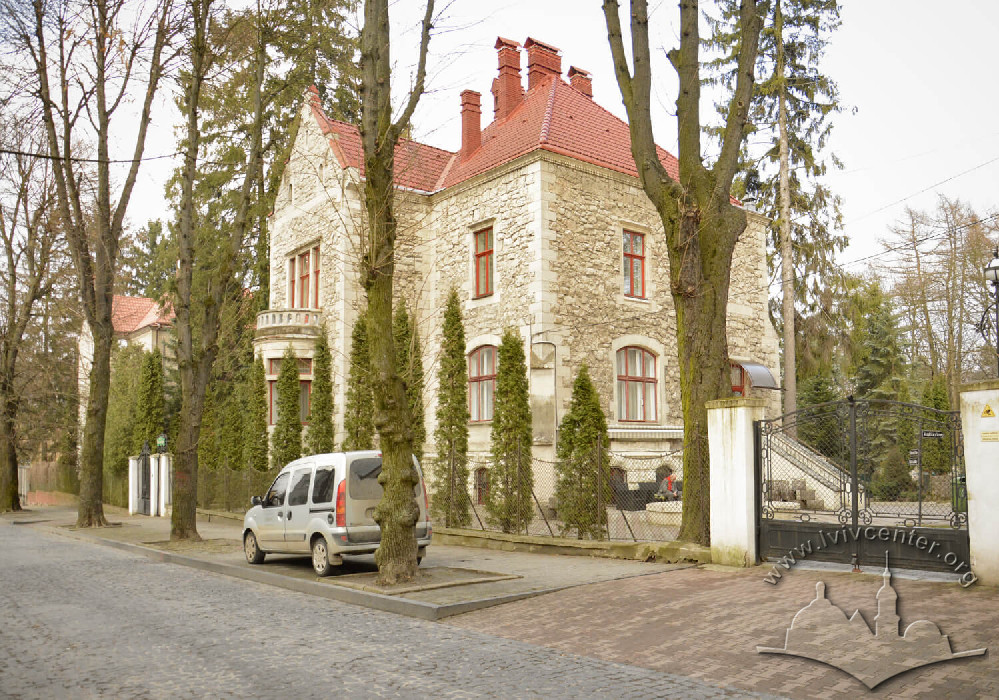
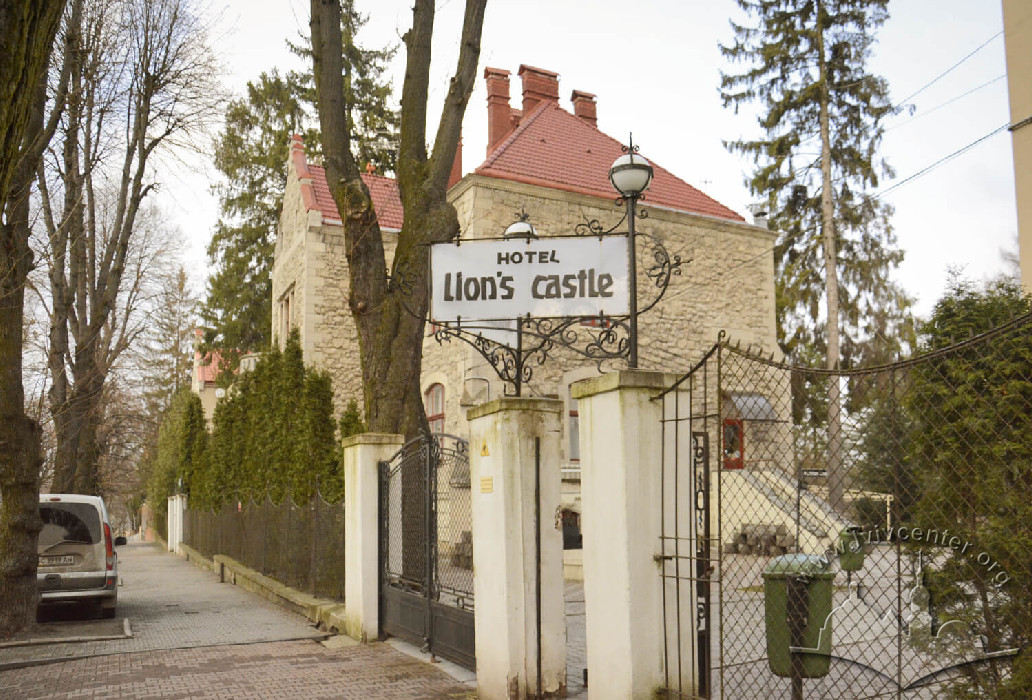
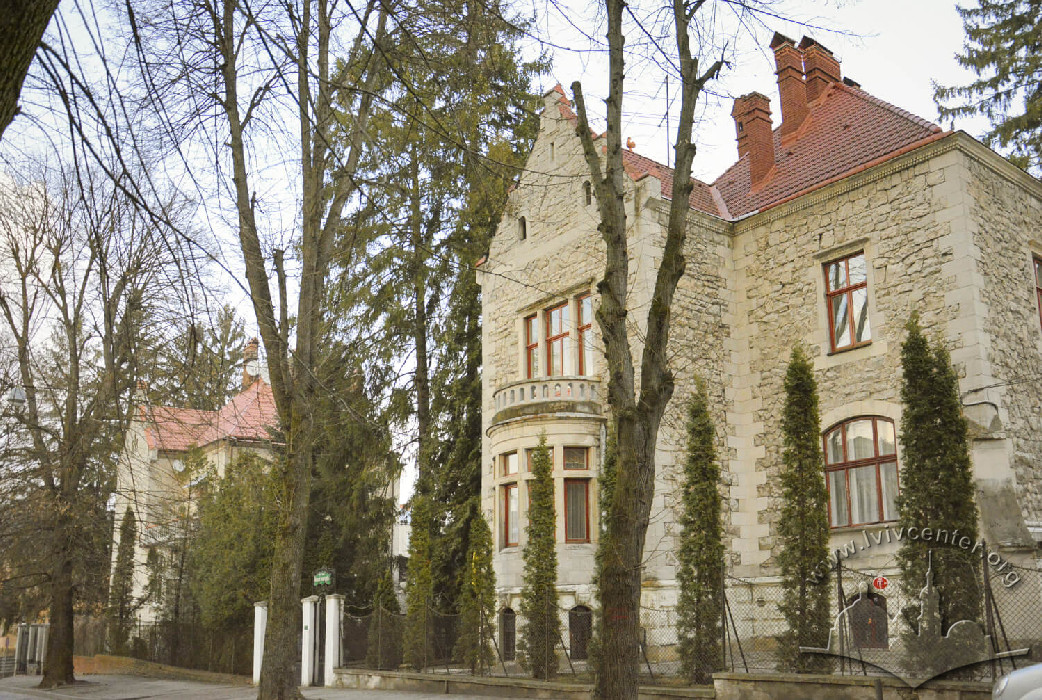
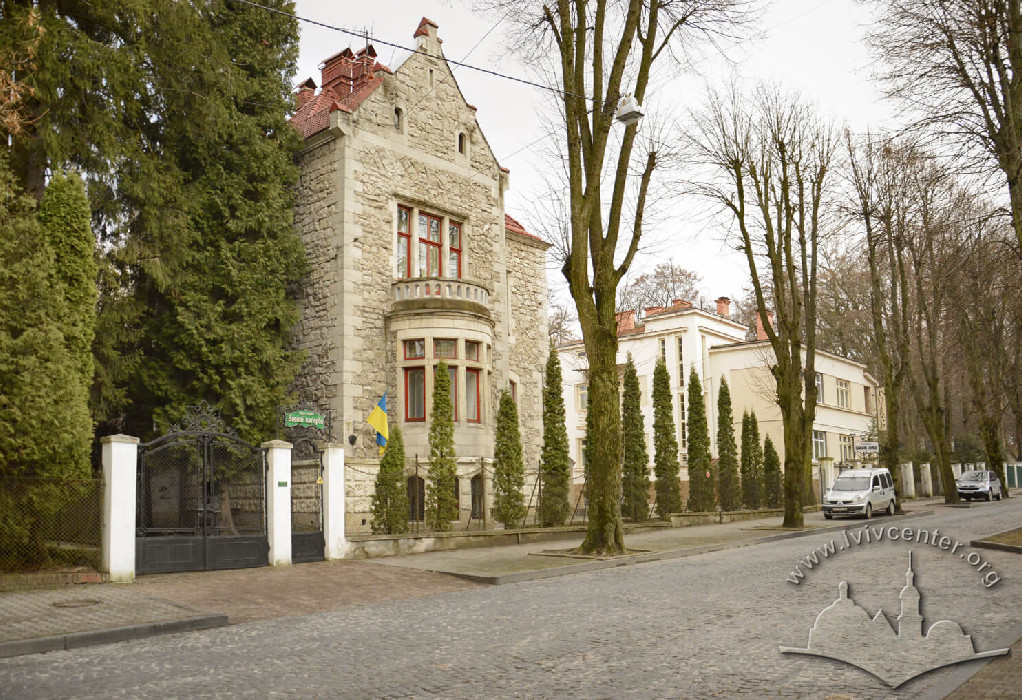
This two-story building was constructed between 1903 and 1904 according to a design by architect Artur Schleyen as a private villa for Herman Feldstein, a prominent Lviv Jewish banker. The villa serves as a striking example of Neogothic architecture, which simultaneously incorporates structural solutions that were highly innovative for the early twentieth century. It is an Architectural monument (Protection No. 1229-M). Today, the building houses the Lion's Castle Hotel.
Story
Ul. Kadecka boczna, which emerged at the beginning of the twentieth century, was once considered one of the most prestigious in the city. Situated within a picturesque, verdant area on the northern slope of the Wulecki Lands, it was developed during the first half of the twentieth century with villas — initially in the Neogothic style (houses No. 1a, 5, and 7), and later, in the 1930s, in the Functionalist style.
In 1913, the street was named in honor of the Polish magnate family, the Herburtowie dynasty. During the German occupation (1943–1944), it was known as Maienstrasse, and in 1945, it was renamed after the Russian composer Mikhail Glinka (1804–1857). Since 2022, it has been named vul. Halytskoi Armii.
The original owner of the villa was Herman Feldstein, a Lviv Jewish banker who later served as the director of the Credit Land Society (Pol. Towarzystwo Kredytowe Ziemskie). As a member of the Lviv City Council, he sat on several committees, including those overseeing debt control, urban landscaping (Pol. plantacyjna), food supply, and statistics. He was highly active in public life; between 1913 and 1915, he managed the Kinetofon Edisona Cinema, located at the building now addressed as prosp. Shevchenka 8.
On November 16, 1903, the Lviv magistrate approved the villa's design developed by architect Artur Schleyen. Construction was completed the following year (ДАЛО 2/1/2262). According to Schleyen's plans, the building was a two-story structure designed in a vibrant Neogothic style. At the time, its address was ul. Kadecka boczna 5, with the conscription number 1602 ¼.
In 1910, the villa became home to the "Prytulok" Society, an organization that cared for children from Jewish families during school vacations. Helena Feldstein, Herman's wife, served as the society's secretary.
During the Soviet era, the building functioned as the residence for the First Secretary of the Regional Committee of the Communist Party of Ukraine (Мельник, 2008, 173). As of 2015, the building houses the Lion's Castle Hotel.Architecture
The villa is a detached structure situated among residential developments from the late nineteenth and early twentieth centuries, south of the city center. Its primary façade faces vul. Halytskoi Armii, and the property is separated from the street by a fence.
As indicated on the original design blueprints, the villa's lot was rectangular in shape. The detached villa is positioned closer to the street front. The recreational area surrounding the villa is divided by walkways and also includes a front garden and a utility zone.
Planning Structure
According to the 1903 design blueprints, the entrance to the villa led through the first floor into a rectangular vestibule housing a staircase. Various rooms were grouped around this central area, including a pantry, kitchen, restroom, cupboard, and veranda, as well as a dining room, living room, and study. Additional exits to the garden were provided from the veranda to the south and from the foyer to the east. The stairwell connected the basement, the first and second floors, and the attic. The second floor contained bedrooms, a foyer, a toilet, a bathroom, and two terraces. The basement level housed the caretaker's quarters, a service room, a laundry room, a toilet, and cellars.
In 1939, architect Jan Jarosz carried out a minor interior remodeling of the villa.
As indicated in the design blueprints, the interfloor ceilings were constructed using Klein system vaults, while the beams were made of reinforced concrete utilizing the Hennebique system — a cutting-edge technology for that era (ДАЛО 2/1/2261). The roof structure was built using wooden rafters.
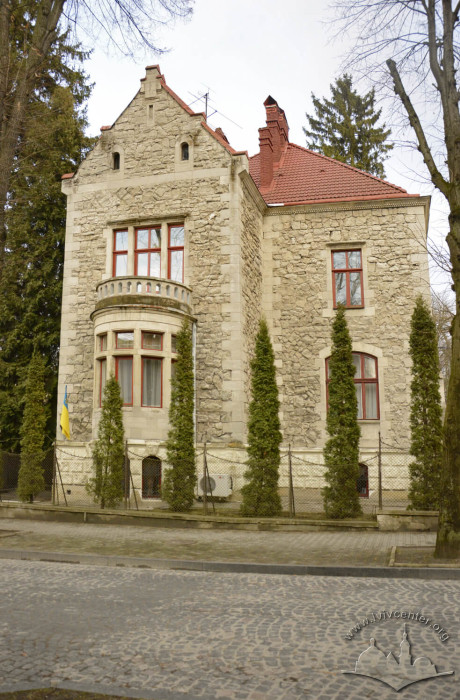
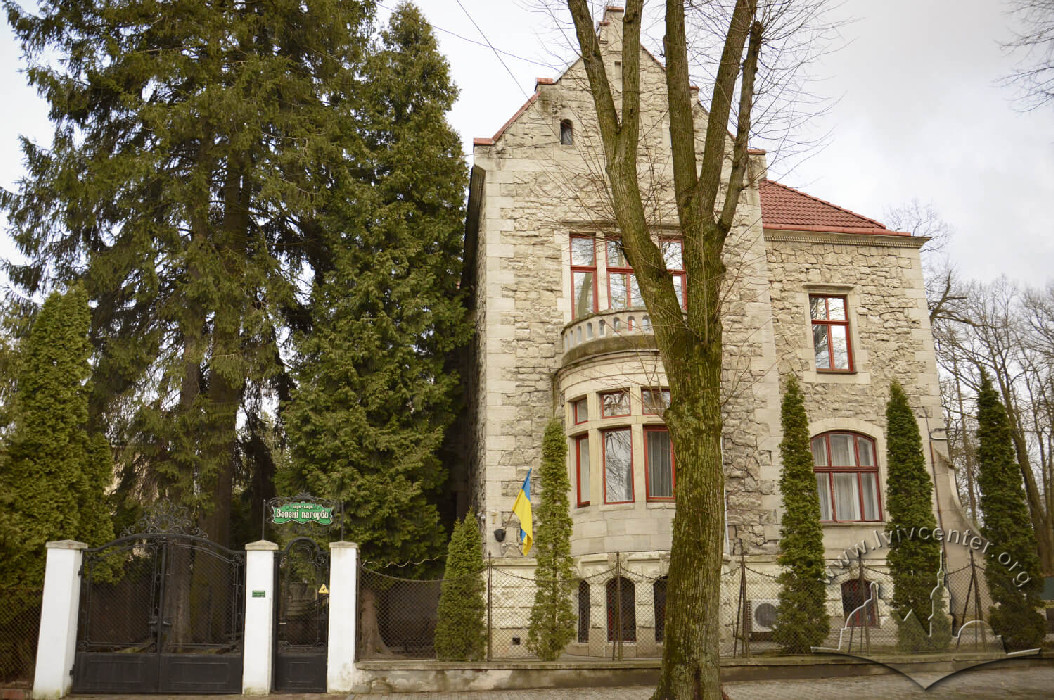
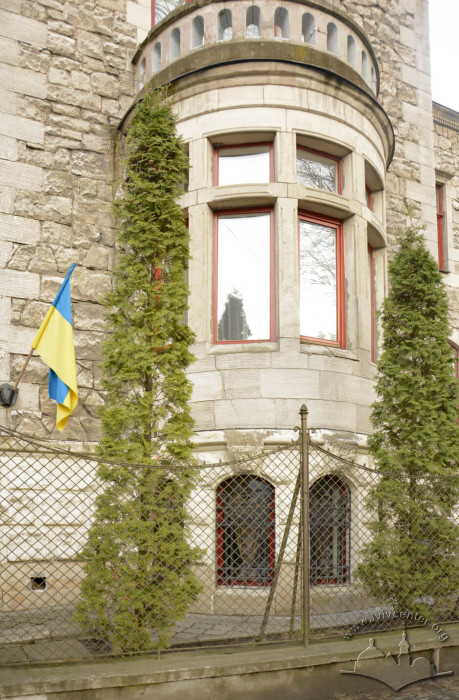
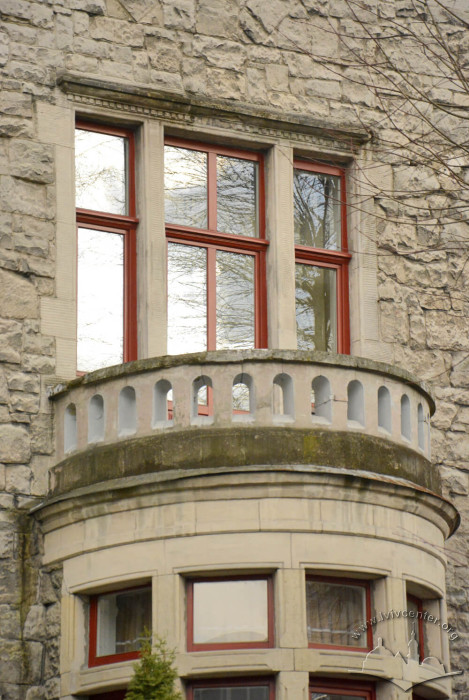
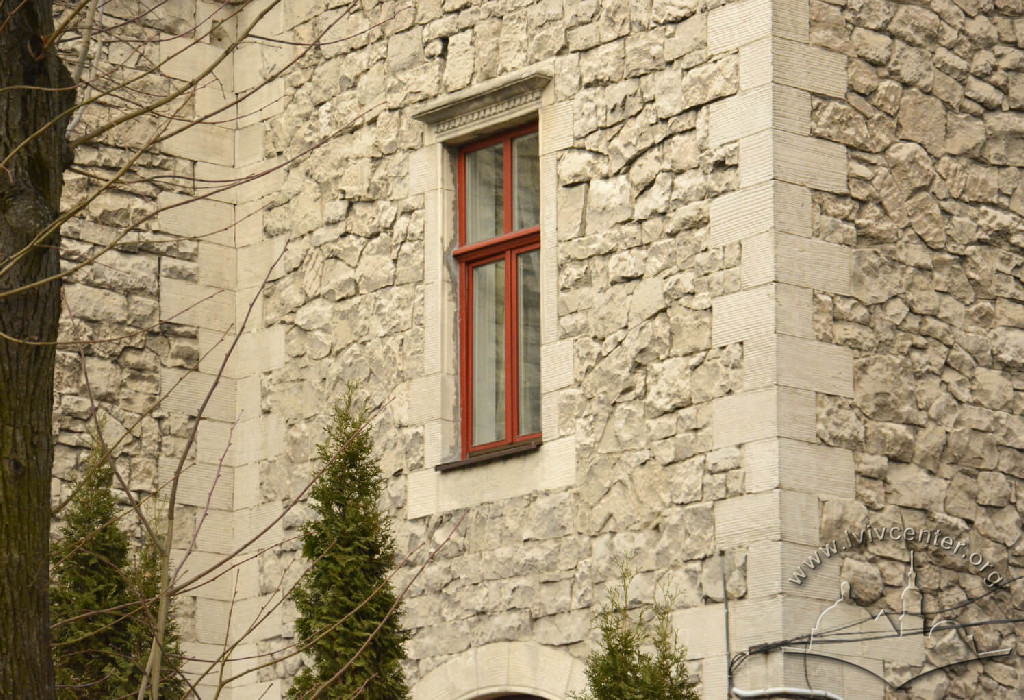
The building's architectural composition is defined by a dynamic and asymmetrical interplay of structural volumes, featuring varying heights and roof forms. The villa is a two-story structure with a rectangular floor plan and a terrace located on the northeastern façade. The textural depth of the façades is achieved through exposed stone masonry combined with lime-sand plaster surfaces, complemented by metal window grilles, terrace railings, and staircase handrails. The entrance to the villa is accessed via stairs leading through a semicircular portal supported by a stylized Gothic column with a capital. The window designs are varied: segmental windows are found at the basement and first-floor levels; rectangular windows appear across the basement, first, and second floors; and semicircular windows are featured on the second floor. A semicircular triforium is located on the first floor. All windows are finished with Gothic plaster frames and decorative keystones.
The primary (western) façade features a semicircular tower at the second-story level, which is topped by a terrace. The stepped gable has a stylized Gothic finish and semicircular dormer windows. The corner where the southern and western façades meet is emphasized by a stylized buttress, while the intersection of the northern and eastern façades is capped by a second-story terrace with stylized railings. The northern façade, which houses the main entrance portal, is adorned with a semicircular window featuring a decorative keystone and a mascaron in the form of a man's face. The roofs are a combination of gabled and hipped designs supported by a profiled cornice.
The stylistic execution of the façades is defined by the use of decorative, stylized Neogothic elements. These include the stepped gable and buttress, as well as the specific profiling and forms of the windows, doors, cornices, and balustrades. Additional characteristic features include the entrance portal with its capped column, a decorative vase, the mascaron, and ornamental metalwork found on the door hinges, window grilles, and lanterns.
Related buildings and spaces
-
Vul. Halytskoi Armii, 1a – O. Novakivskyi Art School (former villa)
-
Vul. Halytskoi Armii, 5 – residential building (villa)
People
Artur Schleyen — a Lviv architect of Jewish descent and a public figure; in 1903, he developed the design for the villa commissioned by the Bernard Feldstein family.
Herman Władysław Feldstein (1863–1935) — a Lviv Jewish banker and director of the Credit Land Society (Pol. Towarzystwo Kredytowe Ziemskie); he was a manager of the Kinetofon Edisona Cinema, a member of the Lviv City Council, a public figure, and the original owner of the villa.
Jan Jarosz — an architect and the author of the villa's reconstruction project.
Helena Feldstein (née Nossig) (~1861–1925) — the wife of Herman Feldstein; she was actively involved in charitable work.
Adolf and Ewelina Borak — the subsequent owners of the villa, who acquired the property in 1935.
Sources
- Державний архів львівської області (ДАЛО) 2/1/2262.
- Світлана Лінда, "Архітектура історизму", Архітектура Львова: Час і стилі ХІІІ–ХХІ ст., ред. Ю. Бірюльов (Львів, Центр Європи, 2008), 410.
- Ігор Мельник, "Вулька і Помірки", Львівський Новий Світ та південні околиці Королівського столичного міста Галичини від Святого Юра до Наварії (Львів, Центр Європи, 2008), 173.
- Львів: Туристичний путівник, ред. Ю. Бірюльов (Львів: Центр Європи, 2004), 304.
- Księga adresowa Małopolski, Lwów-Stanisławów-Tarnopol (Lwów, 1935).
- Księga adresowa król. stoł. miasta Lwowa, rocznik IV (Lwów, 1900).
- Księga adresowa król. stoł. miasta Lwowa, rocznik VI (Lwów, 1902).
- Księga adresowa król. stoł. miasta Lwowa, rocznik XVII (Lwów, 1913).
- Księga adresowa Małopolski, Lwów-Stanisławów-Tarnopol (Lwów, 1935).
- Skorowidz adresowy królewskiego stołecznego miasta Lwowa (Lwów, 1910).
- Skorowidz adresowy królewskiego stołecznego miasta Lwowa (Lwów, 1916).