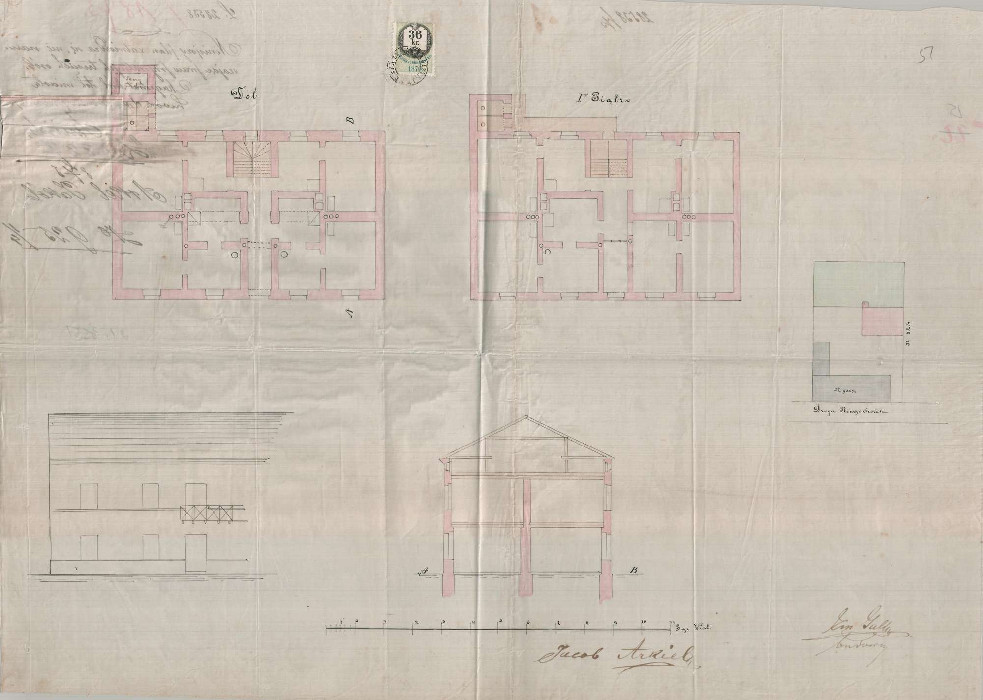
Vul. Bandery, 57 – residential buildings (non-existent) ID: 2702
One- and two-story residential buildings demolished in 1903. From 1871, they were owned by railway conductor Jacob Arkiel and his wife Ewa. An example of tenement housing for poor residents in an area that was considered suburban at that time.
Story
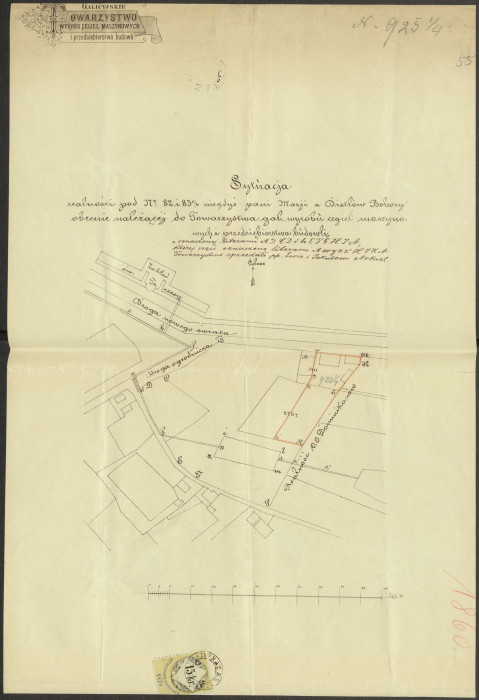
Since the 18th century, the area between what are now vul. Bandery, vul. Konovaltsia, vul. Kyivska, and vul. Antonovycha was occupied by a large plot of land with conscription number 82-83 ¼. In the first half of the 19th century, it was owned by Johann Diestl, probably the restaurateur who founded the beer garden at Pohulianka in Lviv. The plot then belonged to Marya Bobora, née Diestl, and later to the Galician Society for Machine Brick Production (pol. Galicyjskie Towarzystwo Wyrobu Cegiel Maszynowych). In July 1871, part of this plot was purchased by the married couple of Jacob and Ewa Arkiel, who registered it as a separate property under conscription number 925 ¼ (ДАЛО 2/1/3357:1, 55).
In the mid-19th century, this neighborhood, known as Nowy Świat (New World), was the complete opposite of central Lviv. While the medieval city was densely built up with three-story townhouses, the buildings at Nowy Świat had just one floor and were located at a great distance from one another. Although the area was part of Lviv, its character was totally suburban. With the advent of the railway, which began operating in 1861, this situation began to change: infrastructure and various workshops were built near the station, while railway workers started to settle nearby (see Zayarnyuk, 2020, for more details). The apartment buildings that can be seen on vul. Bandery and the surrounding streets today were mostly built in the 1890s–1910s.
The aforementioned Jacob Arkiel moved to Nowy Świat (now vul. Bandery) precisely because of its proximity to the railway. He worked as a conductor at the Karl Ludwig Railway, and the 1868 lifting of government restrictions on where Jews were allowed to settle contributed to this migration. Until 1871, Arkiel and his family would have lived in one of Lviv’s Jewish districts, that in the city center (vul. Fedorovycha / vul. Staroyevreyska) or that suburban (the vicinity of vul. Sianska; for more details, see Moskalets, 2022). Since the Arkiels are not listed in the 1856 and 1863 registers of Lviv homeowners, it can be assumed that thanks to their work, they managed to accumulate some money and become homeowners, albeit of modest properties in the suburbs.
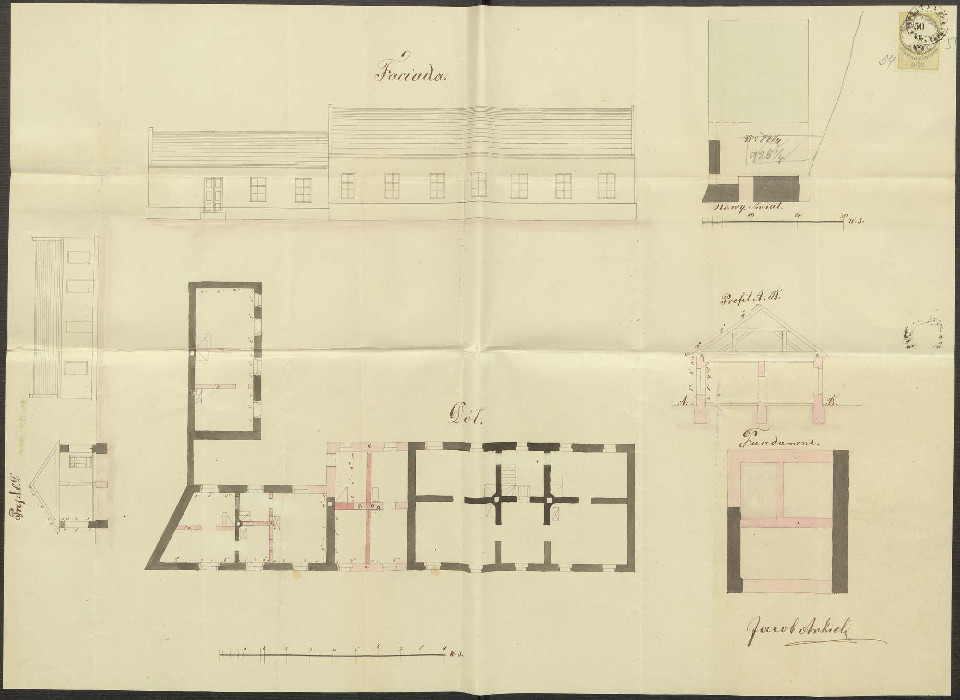
The Arkiels' plot occupied the territory of the modern buildings at vul. Bandery 57, vul. Konovaltsia 4, vul. Konovaltsia 6, and vul. Konovaltsia 8 (partially); its narrower side faced ul. Nowy Świat (now vul. Bandery) and bordered the Dominican monastery estate. As of 1870, there were two single-story residential buildings there: a five-room rectangular one and a two-room one, connected by a wall to a third one — probably a wing for stables, a carriage house, and equipment. The buildings were very simple, without any decoration. There was a garden at the back of the plot (ДАЛО 2/1/3357:54-55). Similar buildings (possibly the same ones) can be seen on maps of Lviv dating back to the early 19th century (1802 map). The Arkiels settled in one of these houses and rented out the rest of the rooms.
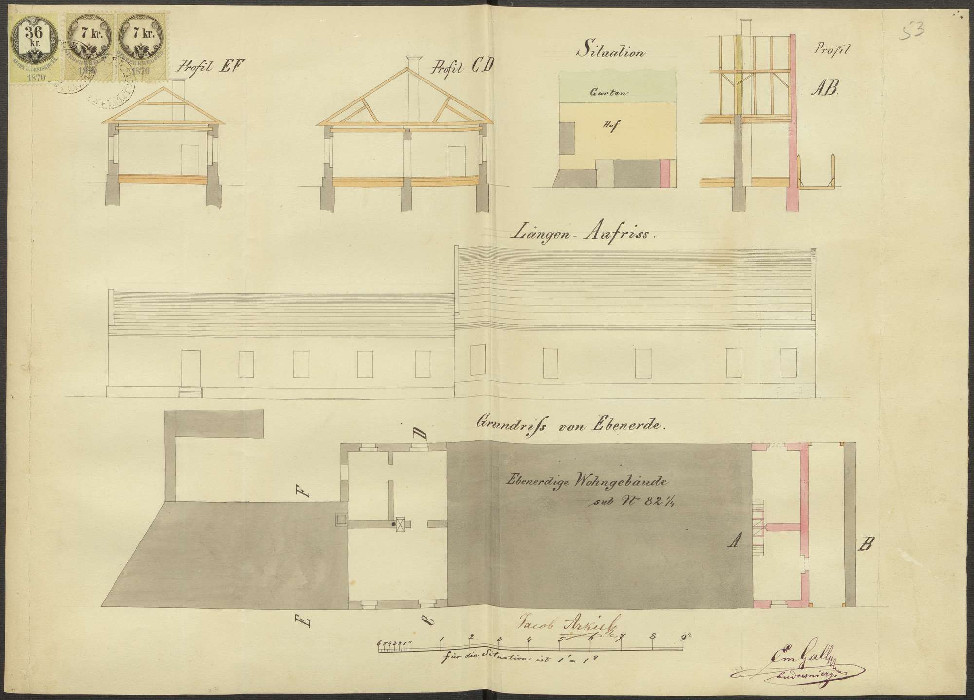
In 1870, the Arkiels had a renovation carried out, the author of which is unknown. The main goal was to increase the living space: larger rooms were divided into smaller ones with brick partitions; the utility wing was reconstructed into three rooms; four more rooms were built between the two houses along the street (ДАЛО 2/1/3357:54). In 1871, two more kitchens were added to the rectangular house, the drawings signed by the constructor Emanuel Gall (ДАЛО 2/1/3357:53).
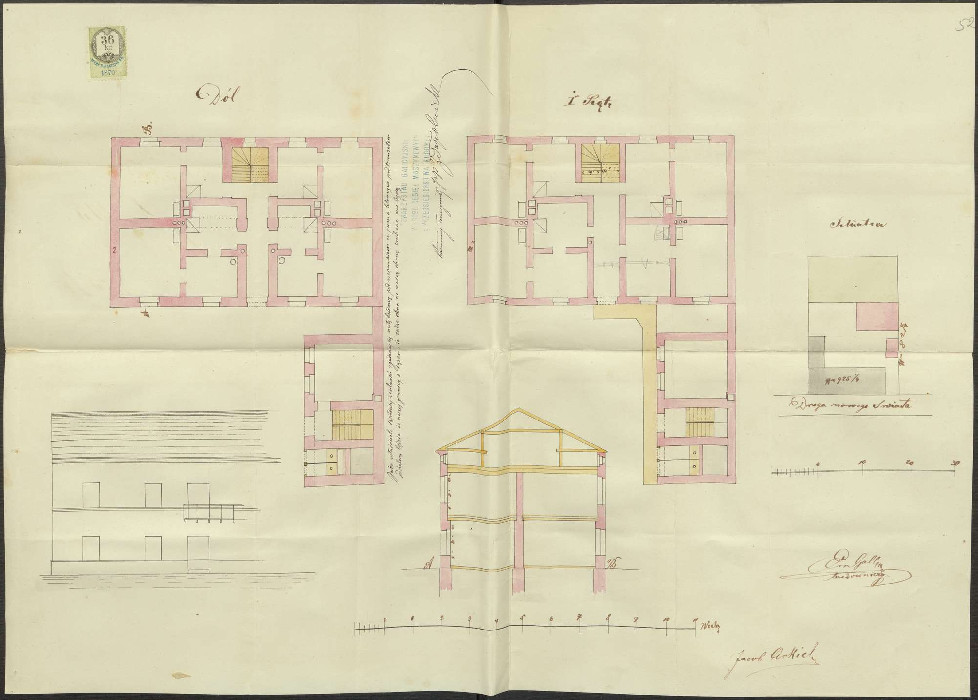
Further expansion of the living space took place in 1873: the Arkiels commissioned a project for another two-story house from Emanuel Gall. In May 1873, a report was filed against Gall as he had started construction works without waiting for official permission from the Magistrate. Justifying his actions, the constructor stated that the construction workers needed extra income before "Ruthenian Easter" and that if he had kept delaying it would have been difficult to find workers. Therefore, he instructed the bricklayers to dig the foundations. This new house had an L-shaped layout, with toilets located at the wing’s edge. During the construction, the plan of building that wing was abandoned, and the house was built rectangular. The owners separately applied to the Magistrate for permission to add the toilets later, in August 1873 (ДАЛО 2/1/3357:18).
In 1878, Magistrate inspectors found that the well on the site did not have a curb high enough: the Building Statute demanded a minimum of 0.8 m, but in fact it was only 0.45 m. Therefore, the Arkiels were required to improve the situation (ДАЛО 2/1/3357:20).
In December 1884, the new head of the Dominican monastery nearby, Benedykt Kundrat, complained about the Arkiels. According to him, he wanted to use the monastery orchards not only for growing fruit but also for recreation and outdoor training of seminarians. However, he was bothered by an unpleasant smell and spoke of a "disgusting impression" from the edge of the orchard adjoining the fence on the border with the plot owned by the Arkiel family, whom he called "Ariels" and emphasized their Jewish origin. What he meant was an open sewage drain on the latter's plot. Kundrat complained that the Arkiels had promised him to fix the situation but actually did nothing (ДАЛО 2/1/3357:21).
In early 1885, engineer Alfred Bojarski with an assistant from the Magistrate’s construction department came for an inspection. They confirmed that there was manure flowing from the stable deep into the plot along the fence while, in another place, household slops were flowing. They demanded that a tightly closed sewage collection tank be built at least two meters from the fence (ДАЛО 2/1/3357:22). The Arkiels responded with an appeal to the City Council: the demand, they claimed, was unreasonable and unfair, since "there were no such tanks on the entire ul. Sapiehy" (as ul. Nowy Świat was renamed in 1886). They had acquired the property several decades earlier and found it in a similar condition, and the sewage had never bothered anyone. However, the Arkiels continued, they were ready to connect to the city sewer system if one appeared on their street (ДАЛО 2/1/3357:24).
The case was further considered by the sanitary section of the City Council, which sent another inspection to the site. In September 1885, members of the City Council and the Magistrate arrived at the Arkiels’ property: Stanisław Ciuchciński and Jan Rudkowski from the construction section, Szymon Schaff and Michał Sembratowicz from the sanitary section, the aforementioned engineer Alfred Bojarski from the Construction Authority, the Magistrate official Aleksander Wysoczański, as well as Franciszek Kosiński, the sanitary doctor of Lviv. They confirmed that the area was densely populated and acknowledged that building a collection tank, as required by the Construction Authority, was too expensive a solution for the poor residents. The inspection concluded that the Arkiels should build a long wooden pipe to carry sewage deep into their own garden, away from the monastery grounds. The City Council approved this decision in December 1885, a year after Father Kundrat's complaint (ДАЛО 2/1/3357:26). The response to the Arkiels included a request to submit a pipe design as soon as possible and to implement it by May 1886 (ДАЛО 2/1/3357:27).
In 1892, an inspector found that part of the building’s firewall facing the street had collapsed. The Construction Authority ordered the wall to be dismantled, the opening to be temporarily closed with boards, and a reconstruction to be carried out (ДАЛО 2/1/3357: 28).
In 1901, inspectors described the condition of the buildings on the Arkiels’ property as "completely neglected", and the Construction Authority demanded that all the buildings be thoroughly renovated. The Arkiels were already elderly and, apparently, instead of looking for ways to repair the buildings, they gifted the property to Dr. Szymon Dawid Arkiel (Kurjer Lwowski, 1901, No. 71:3). The latter, however, sold the plot, and in 1903, it was acquired by the Piramowicz Boarding School Care Society, which demolished all the old houses. A boarding school was built on part of this territory while the part facing the present-day vul. Bandery was purchased by Szulim Lapter, a merchant, who built two townhouses with the present-day addresses of vul. Bandery 57 and vul. Konovaltsia 4.
Architecture
As can be seen on the plans of Lviv, wooden buildings existed on this plot as early as the 18th century; however, there is no detailed information about their appearance and layout. The brick houses, which were purchased by the Arkiel family in 1871, were built in the 1830s and early 1840s: they are absent on the 1829 plan, appearing on the 1844 plan.
The rectangular building along the street had one floor and consisted of six rooms. The entrance was located on the garden side; the hallway had stairs leading to the attic. From the hallway, one could enter a communicating unheated room with one window. On both sides of the hallway, there were kitchens with access to two-window habitable rooms.
Next to this house a two-part building was located, probably a utility wing, which the Arkiels rebuilt into a dwelling in 1871 adding internal walls and stoves. Later, more rooms were added, combining the two houses into one; at the same time, however, the two buildings, constructed at different times, continued to differ in height. The brick and plastered houses had no basements; they had wooden floors, ceilings and roof structures, as well as shingle roofs.
The house, set back from the street, was built in 1873. This symmetrical two-story brick building was rectangular in plan and had a five-window façade. The entrance, located in the center, led to a corridor with a wooden staircase to the second floor at the end. On both sides of each floor, there were two apartments: one- and two-room ones with kitchens. The kitchens in the larger apartments were situated in the middle of the building and had no windows. The toilets were located outside, with access via the courtyard on the ground floor and via a wooden external gallery on the second floor.
Deeper into the property there was a garden; documents also mention a stable, which, however, cannot be seen on the preserved drawings.
Related buildings and spaces
-
Vul. Konovaltsia, 6 – boarding school building

People
Ewa Arkiel — a co-owner of the property in
1870–1901.
Jacob Arkiel — a conductor at the Karl Ludwig
Railway, a co-owner of the property in 1870—1901.
Szymon Dawid Arkiel received the property as a gift in
1901.
Alfred Bojarski — an engineer and an employee of
the municipal Construction Authority.
Aleksander Wysoczański — a Magistrate official.
Emanuel Gall — a constructor who carried out
property renovations in the 1870s.
Johann Diestl — a Lviv restaurateur who owned a
large plot of land at the corner of what are now vul. Bandery, vul.
Konovaltsia, vul. Kyivska, and vul. Antonovycha.
Marya Bobora, née Diestl —
probably the daughter of Johann Diestl, property owner.
Władysław Karwacki — a locksmith who lived in the
townhouse on this plot in 1900.
Bazyli Komarzyński — locksmith who lived in the
townhouse on this plot in 1900.
Franciszek Kosiński — sanitary doctor of Lviv in the
1880s.
Benedykt Kundrat — a monk, the abbot of the
Dominican monastery in Lviv, located nearby in the 19th century.
Szulim Lapter — a merchant who purchased part of
the old plot owned by the Arkiels in the early 20th century and had three-story
townhouses constructed there.
Julia Piotrowska — a midwife who lived in the
townhouse on this plot in 1900.
Jan Rudkowski — a member of the Lviv City Council
and its construction section.
Michał Sembratowicz (1835−1897) — a printer, a member
of the Lviv City Council and its sanitary section.
Stanisław Ciuchciński — a tinsmith, a member of the Lviv
City Council and its construction section.
Szymon Schaff — a lawyer and the head of the Jewish religious community in Lviv, a
member of the City Council and its sanitary section.
Sources
- Державний архів Львівської області (ДАЛО) 2/1/3357. URL: https://e.archivelviv.gov.ua/file-viewer/230136#file-1352462
- Księga adresowa król. stoł. miasta Lwowa, 1900.
- "Wykaz sprzedanych realności w styczniu 1901", Kurjer Lwowski, 1901, Nr. 71, s. 3.
- "Wykaz sprzedanych realności w sierpniu 1902", Kurjer Lwowski, 1902, Nr. 320, s. 3.
- "Wykaz sprzedanych realności we Lwowie", Kurjer Lwowski, 1903, Nr. 261, s. 9.
- Neu verbesserter Wegweiser der Kön. Haupstadt Lemberg, 1863.
- Skorowidz król. stoł. miasta Lwowa, 1871.
- Wegweiser der Kön. Haupstadt Lemberg, 1856.
- Andriy Zayarnyuk, Lviv's Uncertain Destination: A City and Its Terminal from Franz Joseph I to Brezhnev, (University of Toronto Press, 2020), 372.